The demo ended twenty minutes ago. Your champion said “this looks great” and asked you to send over some info. You updated the CRM to “Demo Completed,” fired off a recap email with a recording link, and moved on to your next call.
Two weeks from now, that deal is sitting in your pipeline with no scheduled next step, no identified economic buyer, and a close date you picked because it fell at the end of the quarter. The champion who loved your product is buried in their own priorities, and your follow-up emails are generating opens but zero replies. This is the most common failure pattern in B2B SaaS sales, and it has almost nothing to do with the quality of your demo. The problem is structural: you are sending messages when you should be coordinating a buying process.
After a SaaS demo, document the buyer’s priorities in their own words, resolve the open questions, and confirm one concrete next action with a named owner and a date. For anything beyond a single-stakeholder deal, use a Mutual Action Plan: a shared document of the milestones, owners, dates, and decisions needed to reach an agreed outcome.
The gap between a great demo and a signed contract is rarely about the product. It is about whether both sides agreed on what happens next.
- A recap email is one part of follow-up, not the whole of it. The buyer has more work to do after the demo than the seller.
- A Mutual Action Plan (MAP) is a shared, buyer-confirmed document of milestones, owners, dates, and completion criteria.
- A seller-built timeline emailed to the buyer is not a MAP. It becomes mutual only when the buyer shapes and confirms it.
- Use a follow-up checklist for every demo and a MAP when multiple stakeholders, approvals, or dependencies must be coordinated.
- When a milestone slips, diagnose the blocker with the buyer. Do not just increase your follow-up frequency.
What should happen after a SaaS demo?
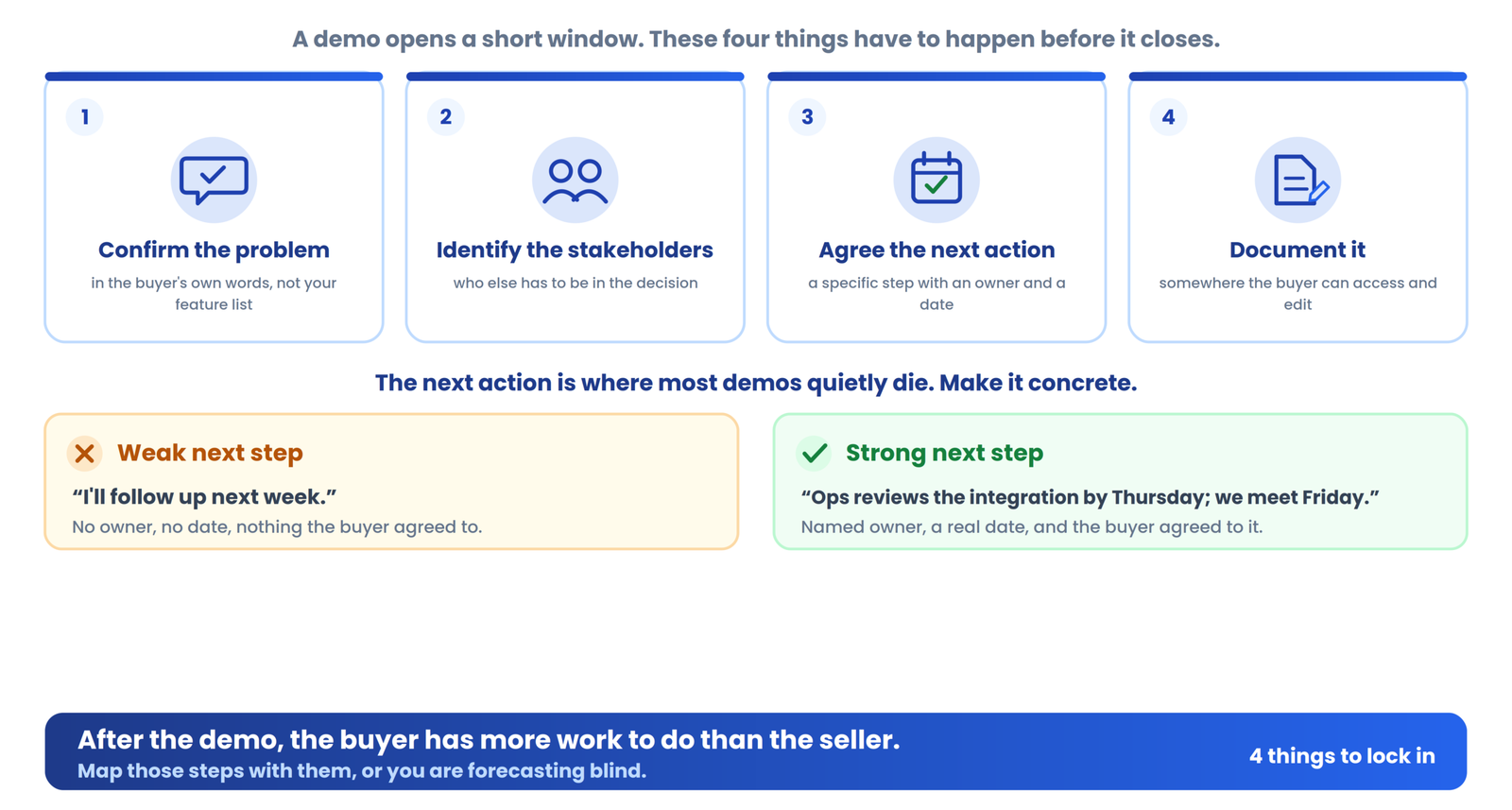
A demo creates a window. The buyer’s attention is high, the problem feels real, and the internal conversation is fresh. That window closes fast. The immediate post-demo period needs to accomplish four things:
- Confirm the business problem in the buyer’s own language, not a list of the features you showed.
- Identify who else needs to be involved in the decision.
- Agree on a specific next action with a date and an owner.
- Document all of it somewhere the buyer can access and edit.
Most teams get the first one partially right with a recap email and skip the rest. They treat the post-demo period as a seller activity: send the recording, send the deck, send pricing, schedule a check-in. Every action is seller-initiated, and the buyer’s only job is to respond. That is backwards. After the demo, the buyer has more work to do than the seller. They need to brief stakeholders, get budget signals, maybe run a security review or compare you against an alternative. If you have not mapped those steps with them, you are forecasting blind.
A weak next step vs a strong one
Weak: “I’ll follow up next week.” No owner, no date, nothing the buyer committed to.
Strong: “Your operations lead reviews the integration requirements by Thursday, and we meet Friday to resolve anything open.” Named owner, real date, and only valid if the buyer actually agreed to it.
A simple next step is enough for a small purchase. A multi-stage evaluation benefits from a shared plan. For the mechanics of booking that first commitment, LevelUp Demo’s guide on what a SaaS demo next step should look like covers the detail.
What is a Mutual Action Plan (MAP) in SaaS sales?
A Mutual Action Plan is a shared document that lists every milestone between “we are interested” and “we are live on the platform,” with a named owner, a target date, and a clear completion criterion for each step. Both the buyer and seller contribute to it, edit it, and use it to track progress.
The word “mutual” is doing real work in that definition. A plan the seller builds alone and emails to the buyer is a project plan for the vendor. It becomes mutual only when the buyer has shaped the milestones, confirmed the owners on their side, and agreed that the dates are realistic given their internal process.
The MAP exists because B2B buying is a group activity with dependencies. Your champion might be ready to move, but procurement needs a security questionnaire completed, legal needs to review your DPA, and the VP of Engineering wants a technical validation session. Without a shared document that sequences these steps and assigns them, everyone defaults to “we will get to it.” Teams that use the MEDDICC qualification framework will recognize the MAP as the mechanism that turns identified pain, a champion, and a decision process into a dated, inspectable plan. If your opportunity has gaps in any of those areas, building the MAP will surface them.
A MAP is a coordination tool. It is not a promise to purchase, a signed agreement, or a guarantee that a deal will close.
Mutual Action Plan vs. sales follow-up checklist
These two look similar in a CRM but serve completely different purposes, and you need both.
| Dimension | Sales follow-up checklist | Mutual Action Plan |
|---|---|---|
| Who creates it | Seller | Buyer and seller together |
| Who sees it | Internal sales team | Both sides, all stakeholders |
| What it tracks | Seller activities (emails, calls) | Buyer and seller milestones |
| How progress is measured | Activity completion | Buyer commitments met |
| When it stalls | Seller sends another email | Both sides discuss the blocker |
| Where it lives | CRM task list | Shared doc, deal room, or workspace |
The checklist tells you what you did. The MAP tells you where the deal is. Confusing them is how teams end up with pipelines full of “active” opportunities where the only recent activity is seller follow-up. For the internal side, the SaaS demo checklist covers how to build that checklist.
What to include in a SaaS Mutual Action Plan
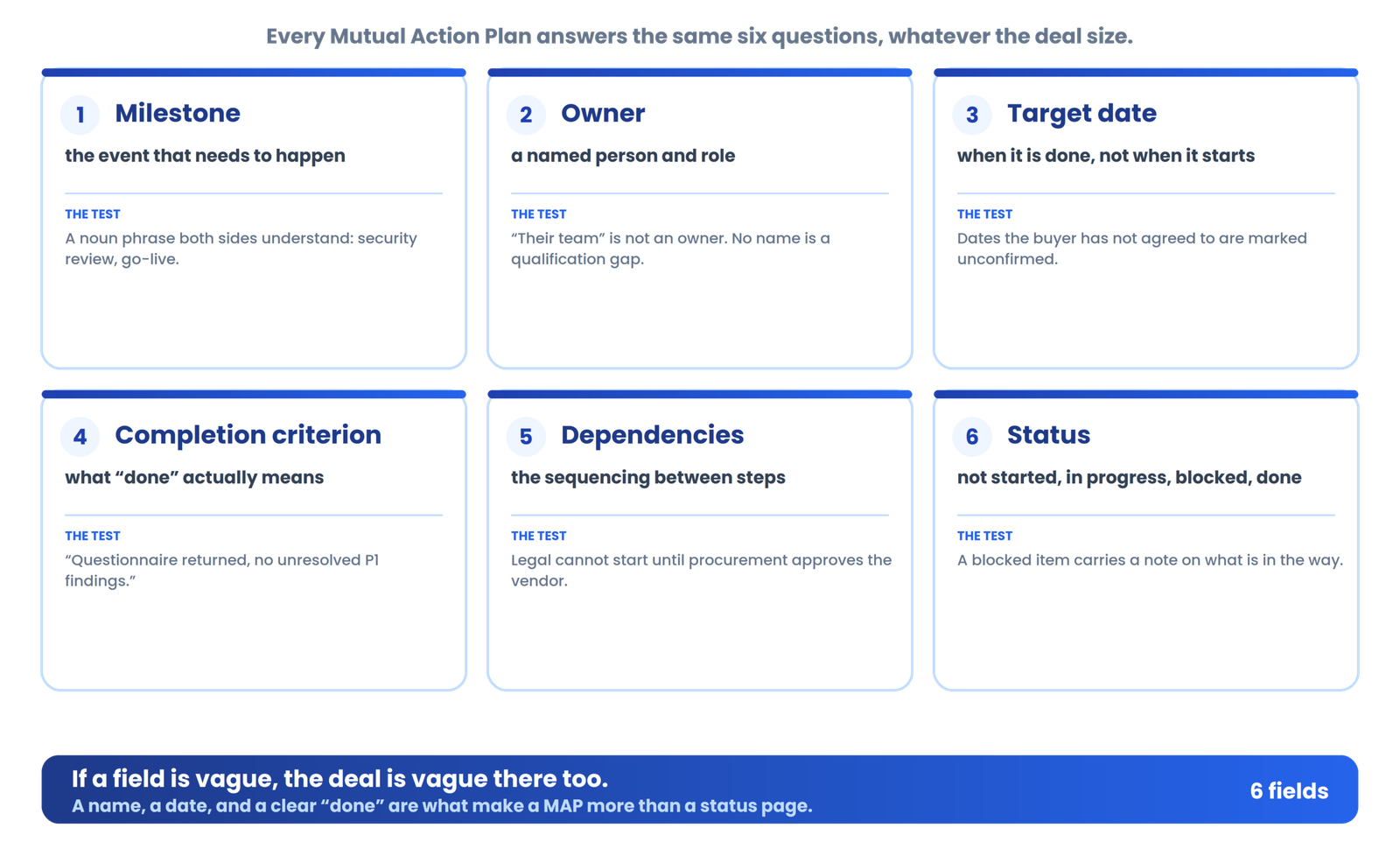
Every MAP answers the same core questions regardless of deal size. The fields scale in complexity, but the structure stays consistent.
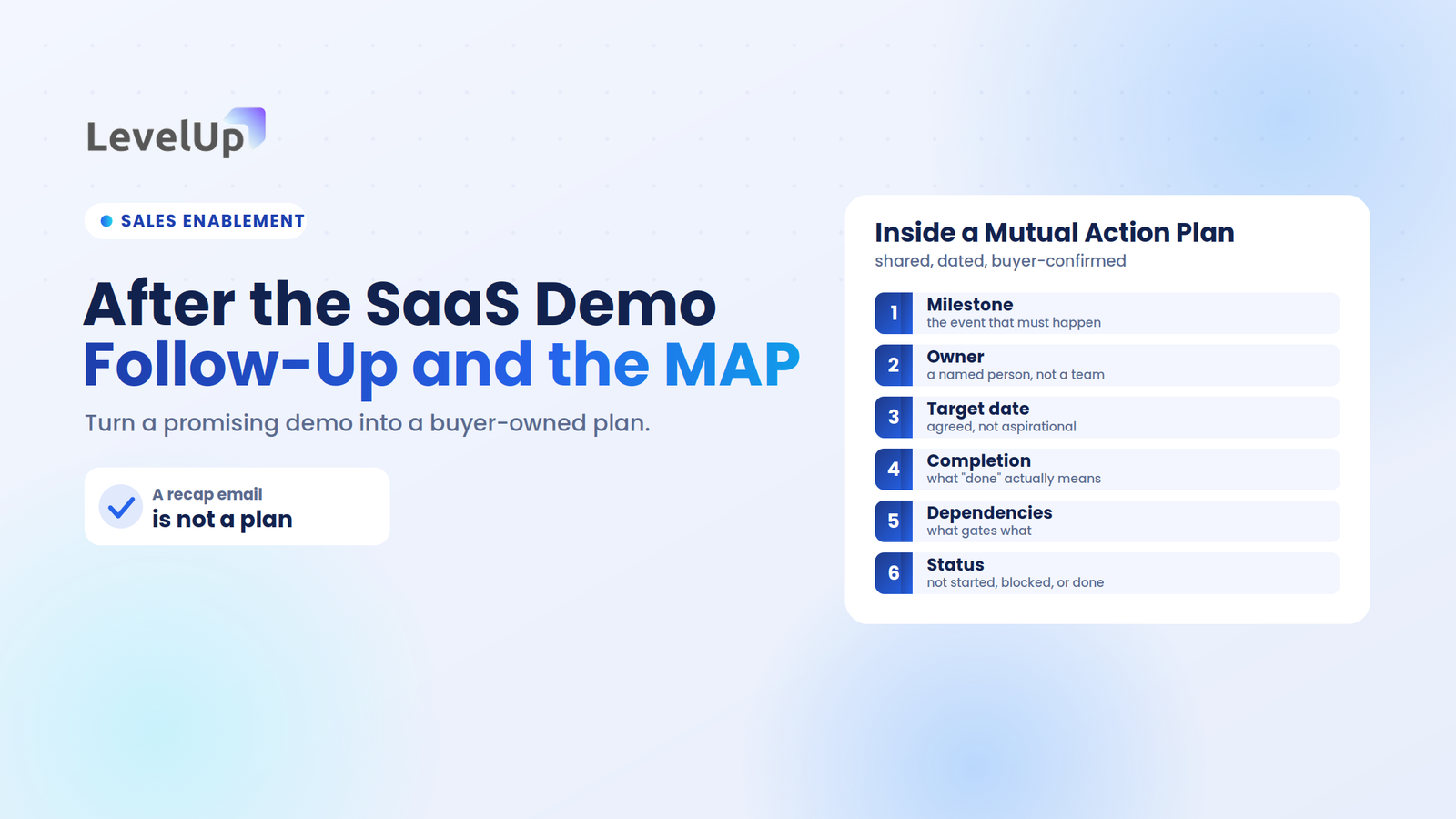
Milestone: the event that needs to happen (technical validation, security review, executive briefing, commercial proposal, legal review, go-live planning). A noun phrase both sides understand without context.
Owner: the specific person responsible. “Their team” is not an owner. You need a name and a role. If you cannot name the owner, that is a qualification gap worth discussing with your champion.
Target date: when the milestone should be complete, not when someone plans to start. Dates the buyer has not agreed to are aspirational, so mark them unconfirmed.
Completion criterion: what “done” means. For a security review, done might mean “questionnaire returned with no unresolved P1 findings.” Without this, milestones linger where the seller thinks they are done and the buyer does not.
Dependencies: the sequencing. Legal cannot start until procurement approves the vendor. Making these explicit prevents the “why hasn’t this moved?” conversation.
Status: not started, in progress, complete, or blocked. Blocked items need a note explaining what is in the way.
How to create a Mutual Action Plan after a SaaS demo
Introduce the MAP during the demo wrap-up or in the first post-demo conversation, not two weeks later when the deal is already cooling. The process is six steps.
1Reconfirm the buyer’s desired outcome
Use the demo discussion to establish what the buyer needs to achieve and how they will judge success. The outcome should reflect their stated priority, not an invented benefit.
2Understand the buying and approval process
Ask how their evaluation and purchasing actually works: who else evaluates, who approves budget, whether security, legal, or procurement reviews are required, and whether a business deadline is driving the decision. Do not assume the demo attendee is the final decision-maker.
3Map the remaining milestones
Draft the sequence from requirements through implementation kickoff. A short list for a mid-market deal, more workstreams for an enterprise one. This is an example sequence, not a mandatory checklist for every deal.
4Assign owners and realistic dates
Give every milestone a named owner on the right side of the table and a date both parties agree to. The buyer may own the technical review while the seller supplies the documentation.
5Share the plan and get feedback
Send the draft for the buyer to review, correct, and approve. A shared document is not mutually agreed simply because it was emailed. If the buyer will not engage with it, that is a signal about authority, priority, or urgency.
6Review and update the plan
Maintain one current version. Update completed milestones, record blockers, revise dates, and add newly identified stakeholders during check-ins. The MAP should reflect the current buying process, not an outdated forecast.
If your MAP lives inside your CRM where the buyer never sees it, it is not mutual. Use whatever format the buyer will actually open and edit, a shared doc, a deal room, a spreadsheet. The access matters more than the format.
SaaS Mutual Action Plan template with an example
Start the plan with a short header: company name, solution being evaluated, shared business objective, buyer champion and decision-maker, target decision date, target implementation date if known, and a last-updated date. Then use this table. Remove the steps you do not need and add any company-specific requirements.
| Milestone | Owner (buyer / seller) | Target date | Completion criterion | Status |
|---|---|---|---|---|
| Confirm business requirements and success metrics | Buyer: [Name] | [Date] | Requirements documented and approved | [ ] |
| Technical validation session | Seller: [SE]; Buyer: [Tech Lead] | [Date] | Solution validated against documented requirements | [ ] |
| Security questionnaire and review | Seller: [Name]; Buyer: [Security Lead] | [Date] | Questionnaire returned, no unresolved P1 findings | [ ] |
| Executive briefing / business case | Seller: [AE]; Buyer: [Exec Sponsor] | [Date] | Executive confirms evaluation proceeds to commercial | [ ] |
| Commercial proposal and review | Seller: [AE]; Buyer: [Procurement/Finance] | [Date] | Terms acceptable or redlines returned | [ ] |
| Legal / DPA review | Seller: [Legal]; Buyer: [Legal] | [Date] | Contract and DPA agreed | [ ] |
| Signature | Buyer: [Exec/Procurement] | [Date] | Contract executed | [ ] |
| Implementation kickoff | Seller: [CS]; Buyer: [Project Lead] | [Date] | Kickoff completed, onboarding plan confirmed | [ ] |
A worked example (fictional)
This example is fictional and is included to show how the template works in practice. It does not represent a real customer or deal. A company is evaluating workflow software, and a technical review becomes blocked on an outstanding question, which pushes the decision date.
| Milestone | Owner | Target date | Status |
|---|---|---|---|
| Confirm reporting requirements for finance | Buyer: Priya (Controller) | Jan 15 | Complete |
| Technical validation with IT | Seller: Jake (SE); Buyer: Marcus (IT) | Jan 22 | Complete |
| Security questionnaire | Seller: Jake; Buyer: Aisha (InfoSec) | Feb 1 | In progress |
| CFO briefing | Seller: Dana (AE); Buyer: Priya + CFO | Feb 8 | Blocked, waiting on security |
| Proposal and pricing review | Seller: Dana; Buyer: Priya | Feb 12 | Not started |
| Legal review | Seller: Legal; Buyer: Outside counsel | Feb 22 | Not started |
| Signature | Buyer: CFO | Feb 28 | Not started |
| Onboarding kickoff | Seller: CS; Buyer: Marcus | Mar 7 | Not started |
Because the security questionnaire is blocked, the CFO briefing cannot proceed, and a named owner takes responsibility for resolving the open question. If the blocker holds, the whole chain of dates shifts, and the plan is updated openly rather than left showing a false green status.
Post-demo follow-up email that introduces the plan
The email should connect the demo discussion to the proposed shared plan. Keep it collaborative, not a closing ultimatum. The example below uses the same fictional cast as above.
What makes it work: it is personalized to their stated priorities, it gives the buyer a clear action, and it presents the plan as something both sides shape rather than a done deal. It does not try to reproduce a full multi-touch cadence.
How to keep the Mutual Action Plan moving when deals stall
Every deal stalls. The MAP’s value shows up precisely when things stop moving. A missed milestone should trigger diagnosis, not an automatic increase in follow-up frequency.
| Problem | Likely root cause | What to do |
|---|---|---|
| Buyer says “send me information” and goes quiet | No agreed outcome or dated next action | Reply with a short decision path: proceed on a date, defer to a date, or close the evaluation |
| MAP dates keep slipping | Dates were seller-created, not anchored to buyer dependencies | Ask the buyer to re-confirm each date and mark blocked items explicitly |
| Champion is responsive but nothing progresses | Champion lacks internal authority or capital | Ask what they need to prove internally and who controls budget, security, and procurement |
| A new stakeholder appears and resets things | The buying committee was not fully mapped | Add them to the MAP, schedule a session, and ask who else might surface |
| Legal or security review drags | No one owns the timeline on the buyer side | Ask for a named contact and a realistic review window |
| Buyer stops responding | Priorities or timing may have changed | Ask directly whether this is still active, or the timing is not right |
The pattern across all of these: the fix is a conversation with the buyer about the plan, not another follow-up email from the seller. A plan that honestly shows “blocked” is more useful than one that shows a fake green status. And repeated delays, missing ownership, and no confirmed next step may mean the opportunity needs to be reassessed, not every stalled deal can be recovered with a MAP.
How to measure whether your post-demo process is working
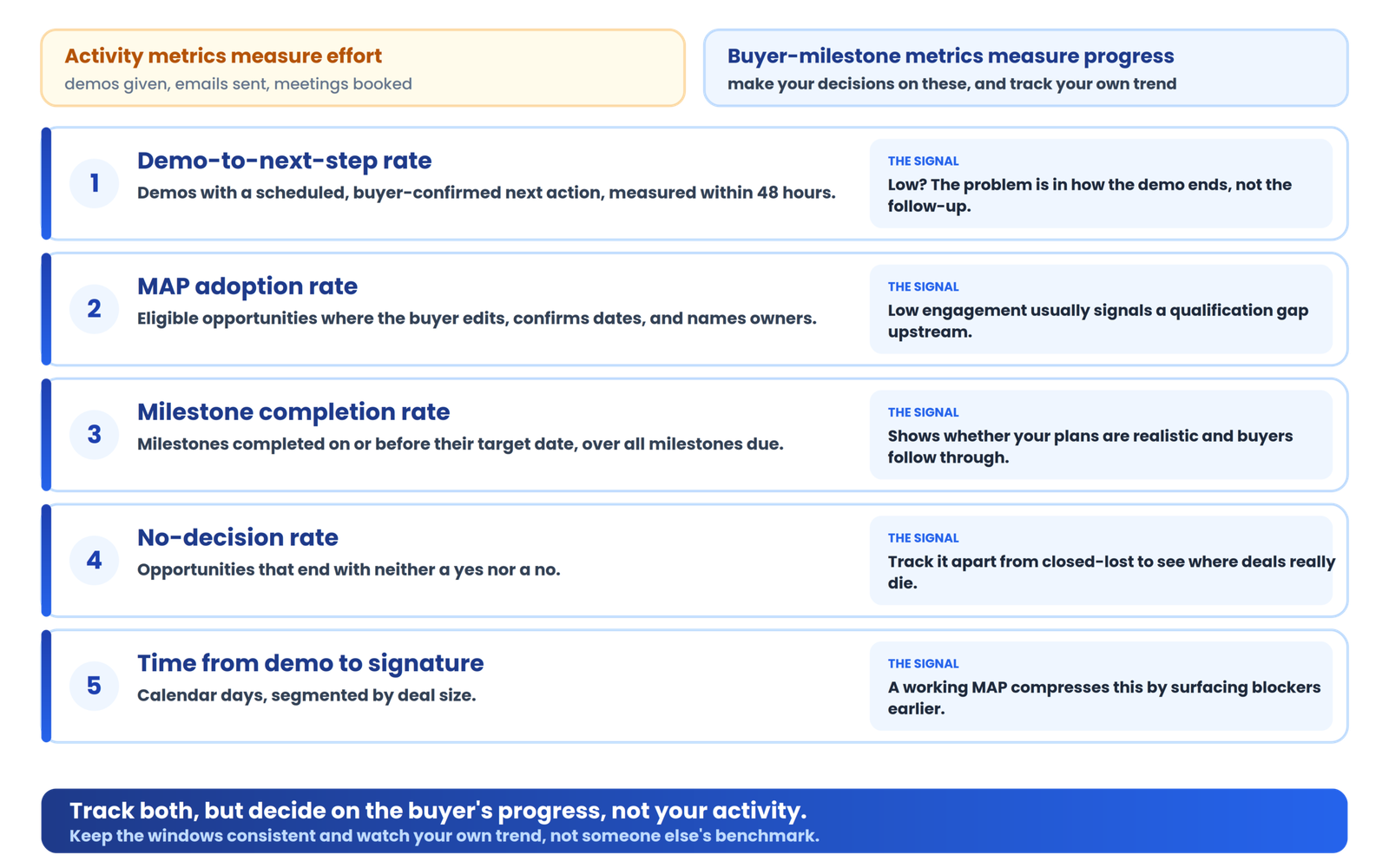
Activity metrics measure effort. Buyer-milestone metrics measure progress. Track both, but make decisions based on the second. Define eligibility and measurement windows consistently, and do not borrow outside benchmarks, track your own trend.
Demo-to-next-step rate: demos that produce a scheduled, buyer-confirmed next action, divided by total demos, measured within 48 hours. If a large share of demos end with no confirmed next step, the problem is usually in how the demo ends, not the follow-up.
MAP adoption rate: eligible opportunities where the buyer actively engages with the MAP (edits, confirms dates, names owners), divided by total eligible opportunities, times 100. Low engagement usually signals a qualification gap upstream.
Milestone completion rate: milestones completed on or before their target date, divided by total milestones due. Tells you whether your plans are realistic and whether buyers follow through.
No-decision rate: opportunities that end without a yes or no, divided by total opportunities. Tracking this separately from “closed lost” gives a clearer picture of where deals actually die.
Time from demo to signature: measured in calendar days and segmented by deal size. A working MAP should compress this over time by surfacing blockers earlier.
Keep every post-demo next step visible
LevelUp Demo helps sales teams organize demo follow-up and keep the agreed next steps and owners in view, so stalled deals surface before they go stale. See how it fits your pipeline.
Frequently asked questions
What should you do immediately after a SaaS demo?
Document the outcome in the buyer’s own words, summarize their requirements and open questions, resolve anything the demo did not answer, and confirm one specific next action with a named owner and a date. For complex deals, start a Mutual Action Plan.
When should I introduce the Mutual Action Plan to the buyer?
During the demo wrap-up or in your first post-demo conversation. The MAP works best when it is built from the buyer’s own description of their evaluation and approval process. Waiting two weeks loses the window where their attention and internal momentum are highest.
Does every deal need a MAP?
No. A self-serve or single-stakeholder deal that closes in one or two calls does not justify a formal plan. A MAP adds value when multiple stakeholders, approvals, security or procurement reviews, or a longer timeline must be coordinated.
What should a SaaS Mutual Action Plan include?
A shared business objective, the stakeholders and their decision roles, evaluation milestones with completion criteria, a named owner and agreed date for each, the dependencies between steps, current status, and the intended decision and implementation dates.
Is a Mutual Action Plan the same as a sales follow-up checklist?
No. A follow-up checklist tracks internal seller activities. A MAP is a shared buyer-and-seller plan that tracks the milestones and commitments needed to reach a decision. Use the checklist for every demo and the MAP for coordinated, multi-step evaluations.
What if the buyer will not engage with the MAP?
Treat it as diagnostic information. A buyer who will not review or edit the plan is signaling something about priority, authority, or urgency. Ask directly whether the evaluation is active or the timing is wrong. A clear “not now” beats months of optimistic follow-up.
What should you do if a prospect stops responding after a demo?
Go back to the last agreed step, ask whether priorities or timing have changed, and update the opportunity based on what you learn rather than sending more follow-ups. Reassess the deal honestly if there is no confirmed next step.
Turn your SaaS demo into a clear buying plan
The gap between a great demo and a signed contract is almost never about product quality. It is about whether both sides know what happens next, who is responsible for each step, and when each milestone needs to be done. A MAP will not save a deal that should not close, but it will tell you, clearly and early, which deals are real and which are stalled behind vague enthusiasm. Shared milestones, named owners, realistic dates, and genuine buyer participation are what turn a promising demo into a buying process you can actually read.
Give your demo follow-up a system
LevelUp Demo helps your team capture demo outcomes and keep follow-up actions and owners organized across the pipeline, so the next step is never a guess. Take a look.