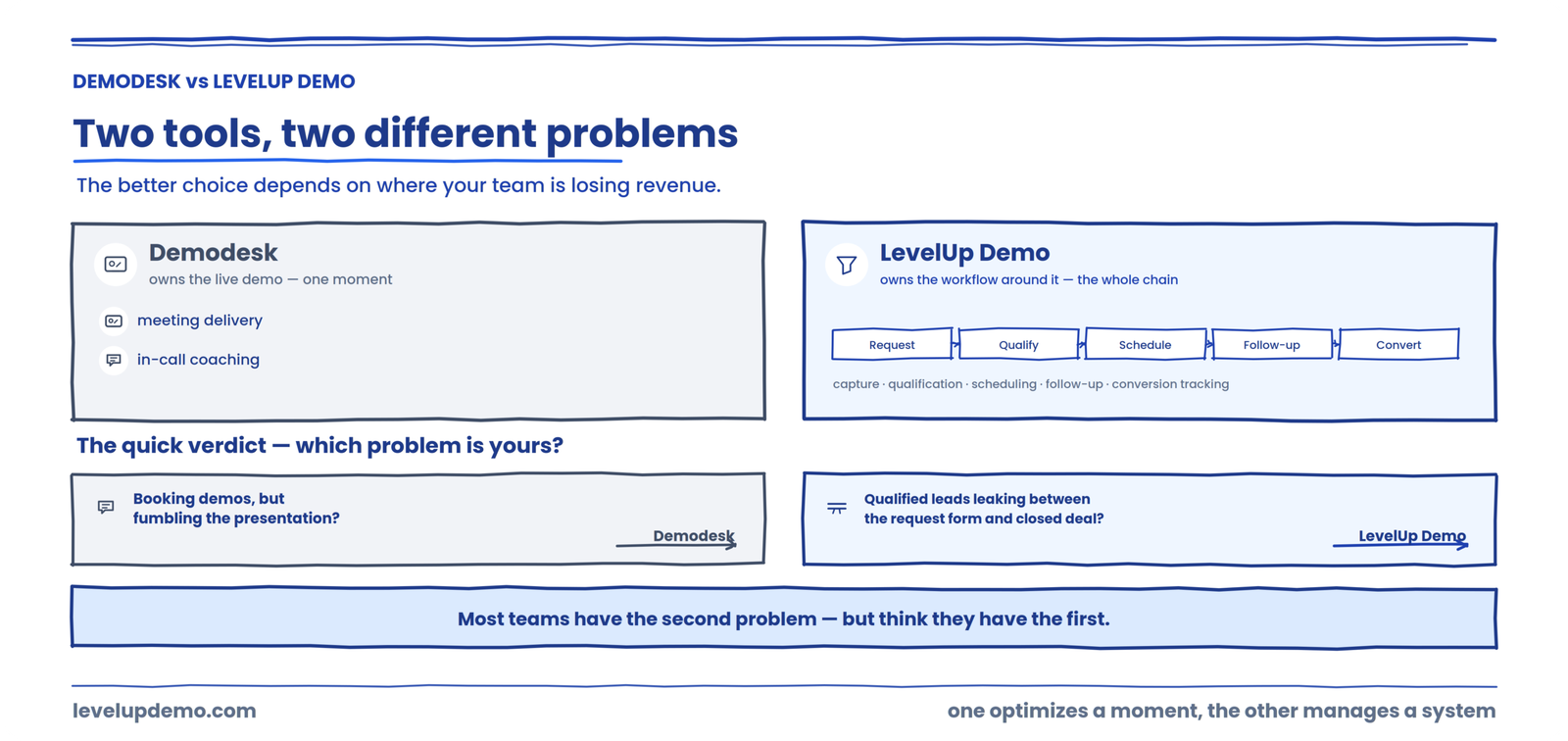
Demodesk and LevelUp Demo solve different problems in the SaaS demo process. Demodesk is primarily focused on the live demo experience, including meeting delivery and coaching, while LevelUp Demo is built around the operational workflow surrounding demos, from request capture and qualification through scheduling, follow-up, and conversion tracking. The better choice depends on where your team is losing revenue.
The quick verdict
If your reps are booking demos but fumbling the presentation, Demodesk is purpose-built for that problem. If qualified leads are leaking out between the request form and the closed deal because nobody owns the workflow, LevelUp Demo is the stronger fit. Most SaaS teams I talk to have the second problem and think they have the first.
Demodesk vs LevelUp Demo at a Glance
| Category | Demodesk | LevelUp Demo |
|---|---|---|
| Primary focus | Live demo experience | End-to-end demo operations |
| Demo delivery | Strong | Supporting workflow |
| Demo coaching | Strong | Not the primary focus |
| Demo request capture | Limited | Core workflow |
| Lead qualification | Limited | Core workflow |
| Lead routing | Not the primary focus | Core workflow |
| Pre-demo workflow | Limited | Core workflow |
| Post-demo follow-up | Limited | Core workflow |
| Demo outcome tracking | Limited | Core workflow |
| Demo funnel visibility | Limited | Core workflow |
| Demo-to-revenue tracking | Limited | Stronger fit |
| Best for | Teams optimizing live demo delivery | SaaS teams managing the entire demo lifecycle |
What’s the Actual Difference?
Forget company origin stories. The distinction that matters sits in the demo lifecycle itself:
Request → Qualification → Routing → Scheduling → Preparation → Demo → Follow-up → Outcome → Conversion → Analytics
Demodesk lives in the middle of that chain. It makes the live meeting better. LevelUp Demo wraps around the entire sequence, treating each stage as a connected demo workflow with triggers, owners, and outputs. One optimizes a moment. The other manages a system.
That is not a quality judgment. It is a category distinction. And confusing the two is how SaaS teams end up buying the wrong tool and blaming “the software” six months later.
What Demodesk Is Best At
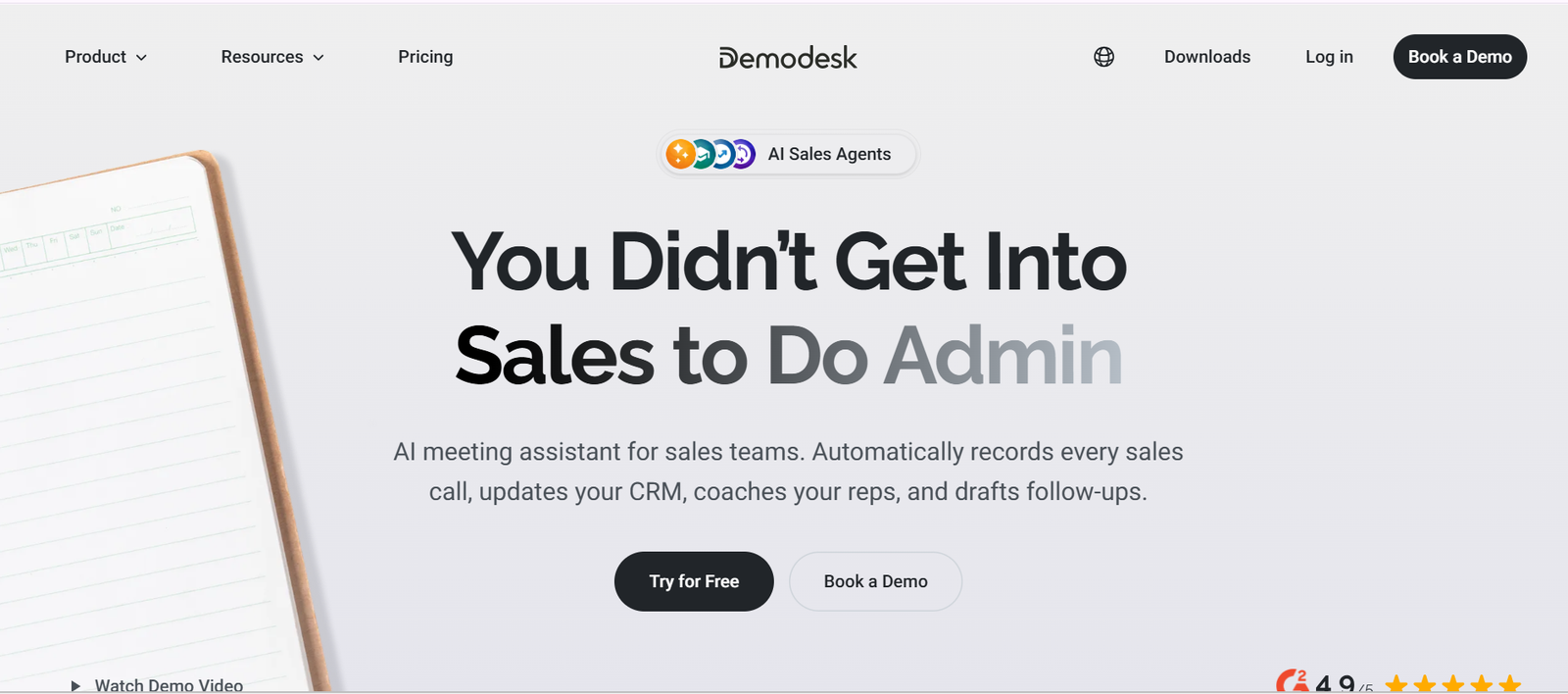
Demodesk earns its reputation in the room where the demo happens. Its virtual meeting environment is built specifically for sales presentations, not repurposed from a general video call tool. Reps get a browser-based screen share that doesn’t require downloads from the prospect, pre-loaded talk tracks, and real-time coaching prompts that appear during the conversation.
For sales managers who spend their afternoons reviewing call recordings and marking the exact timestamp where a rep went off-script, Demodesk’s coaching layer is genuinely useful. The playbook feature lets you standardize demo structure across a team without turning every rep into a robot reading slides.
Where Demodesk makes sense
Your team books 40 demos a week. Prospects show up. But close rates sit at 12% when they should be north of 20%. Reps ramble. Discovery questions get skipped. The product walkthrough doesn’t match the prospect’s pain. That is a demo delivery problem, and Demodesk is a logical category fit.
The friction
Demodesk’s strength is also its boundary. Once the meeting ends, the operational workflow thins out. What happens to the prospect who said “send me a proposal by Thursday”? Who tracks that? Where does the demo outcome live in a way the whole revenue team can see? Those questions sit outside Demodesk’s primary design.
What LevelUp Demo Is Best At
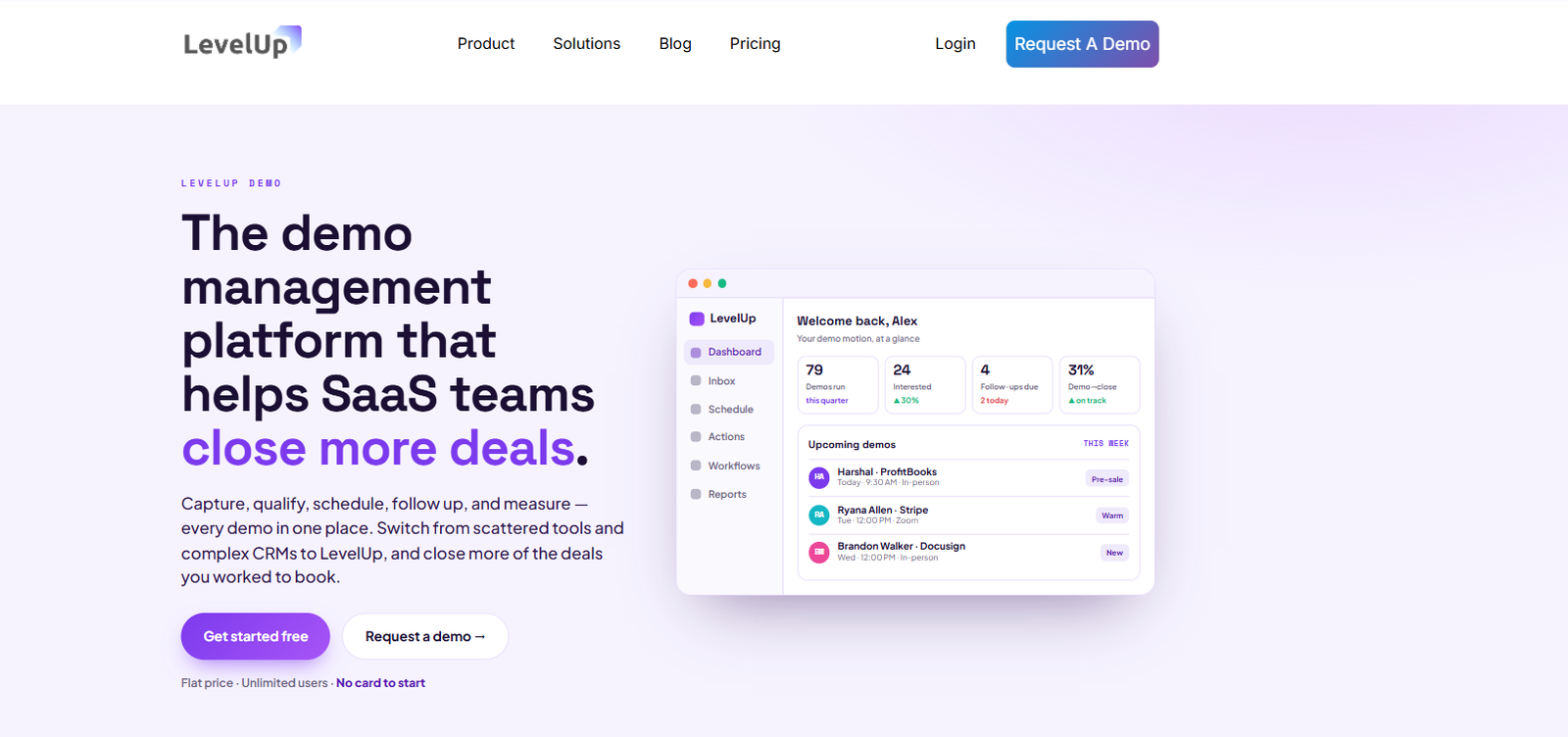
LevelUp Demo treats the demo as a process, not an event. The demo operations framework it’s built around breaks the lifecycle into three zones:
Before the demo: Request capture, qualification against ICP criteria, lead enrichment, routing to the right rep, scheduling with context, and preparation so the AE walks in knowing the prospect’s stack and pain points.
During the demo: Workflow continuity. The rep sees qualification data, enrichment notes, and routing context without toggling between four tabs. Demo status is tracked in real time. Outcome capture happens at the point of action, not three days later when a manager asks “how’d that call go?”
After the demo: Follow-up sequences, next-step tracking, outcome classification, conversion visibility, and demo operations KPIs that tell you where the funnel is actually leaking.
The friction
LevelUp Demo is not trying to replace your meeting platform. If your core problem is that reps deliver weak presentations and need in-call coaching overlays, LevelUp Demo’s workflow engine doesn’t solve that specific moment. It manages everything around it.
Feature-by-Feature Comparison
Demo Request Management
The question that reveals the gap: What happens in the 90 seconds after someone clicks “Request a Demo” on your website?
Demodesk connects to scheduling. The prospect books a slot. That is functional. But the space between “request submitted” and “meeting booked” is where SaaS teams hemorrhage qualified pipeline. Demodesk treats this as a scheduling problem.
LevelUp Demo treats it as an operations problem. The request triggers qualification, enrichment, and routing before anyone’s calendar gets involved. A demo request without qualification is just another inbox item.
Lead Qualification
Can the system capture qualification data at the point of request? Can teams distinguish ICP fits from tire-kickers before an AE spends 45 minutes on a call that was never going to close?
Demodesk’s qualification capabilities are secondary to its meeting focus. LevelUp Demo builds qualification into the core workflow, capturing firmographic and intent signals that travel with the lead through every subsequent stage. That distinction matters when your team runs 200 demos a month and 60% of them are with prospects who were never a fit.
Lead Routing
Capture without routing is another inbox. That line keeps proving true across every SaaS team I’ve watched try to scale demos with duct-taped processes.
Demodesk offers routing in the context of meeting assignment. LevelUp Demo offers routing as part of the operational decision layer, factoring in qualification score, territory, product line, rep capacity, and custom rules. The difference shows up at 50+ demos per week, when manual routing becomes the silent bottleneck nobody tracks.
Scheduling
Both tools handle calendar integration, booking, and confirmations. Comparing them on “has scheduling” is like comparing cars on “has wheels.”
The real question: where does scheduling sit in the workflow? In Demodesk, scheduling is close to the entry point. In LevelUp Demo, scheduling is a downstream output of qualification and routing. A prospect who doesn’t meet ICP thresholds gets a different path than one who does. That conditional logic changes how your calendar fills up and, more importantly, with whom.
Post-Demo Follow-Up
This is where the operational gap becomes measurable. After a demo ends in Demodesk, the workflow largely depends on whatever your team has built in the CRM or a task manager. The meeting happened. What comes next is your problem.
LevelUp Demo keeps the thread alive. Follow-up tasks, next steps, outcome status, and conversion tracking live inside the same workflow that captured the original request. Nothing falls into the gap between “great demo” and “closed deal.”
Before, During, and After: The Three-Zone Test
| Zone | Demodesk | LevelUp Demo |
|---|---|---|
| Before the demo | Scheduling-focused | Full operational workflow |
| During the demo | Strong meeting environment | Workflow context and outcome capture |
| After the demo | Limited post-demo workflow | Follow-up, outcomes, conversion tracking |
A great demo is only one stage of a demo process. If your team’s revenue problem lives in the other stages, optimizing the meeting alone won’t move the number.
Optimizing the meeting alone won’t move the number
If your revenue leaks before or after the demo, LevelUp Demo manages the whole lifecycle — request, qualification, routing, scheduling, follow-up, and outcomes — as one connected workflow.
Which Tool Fits Your Specific Problem?
Choose Demodesk if:
✓ Demos are already being booked consistently
✓ The bottleneck is presentation quality
✓ Reps need real-time coaching
✓ Meeting experience is the primary concern
✓ Your operational workflow already works
Choose LevelUp Demo if:
✓ Leads slip between request and booking
✓ Qualification is inconsistent or nonexistent
✓ Routing is manual and error-prone
✓ Reps lack context walking into demos
✓ Follow-up gets forgotten
✓ Demo outcomes aren’t tracked
✓ You can’t see where pipeline leaks
✓ Your CRM only tells you “demo happened”
The Hidden Question: Demo Software or Demo Operations Software?
Most SaaS teams searching for “demo software” are actually describing an operations problem. Here’s the diagnostic:
| If your problem is… | You need… |
|---|---|
| Weak live presentations | Demo delivery software |
| Slow lead response | Workflow automation |
| Inconsistent qualification | Qualification workflow |
| Manual routing | Routing automation |
| Scheduling friction | Scheduling workflow |
| Forgotten follow-ups | Follow-up management |
| No post-demo visibility | Outcome tracking |
| Poor demo-to-close rates | Demo intelligence and analytics |
That framework is more useful than any feature checklist.
Can You Use Both Together?
Yes. A team could run LevelUp Demo as the operational backbone and Demodesk as the meeting layer. That makes sense when both problems are real: you need workflow management and you need a specialized meeting environment.
But don’t stack tools for the sake of coverage. If your operational workflow is the bottleneck, fixing the meeting experience first is like repainting a house with a cracked foundation. Ask which problem is costing you more revenue right now.
Quick Picks by Team Size
| Team | Primary Problem | Better Fit |
|---|---|---|
| Solo founder | Don’t lose inbound requests | LevelUp Demo |
| 2-10 person sales team | Qualification, scheduling, accountability | LevelUp Demo |
| Growing sales org | Standardizing demo process across reps | LevelUp Demo (operations) or Demodesk (delivery), depending on bottleneck |
| Large sales org | Workflow consistency and reporting | LevelUp Demo for operations layer |
When neither is the right answer: If your actual problem is that nobody is requesting demos in the first place, neither tool fixes a demand generation gap. Solve traffic and messaging first, then systematize the workflow that handles inbound interest.
AI-Powered Demo Workflows
Where AI automation fits into demo operations is practical, not theoretical.
Pre-demo research prompt
“Analyze this company and prepare a 5-minute pre-demo brief covering its industry, likely pain points, relevant use cases, potential objections, likely stakeholders, and three discovery questions.”
Qualification prompt
“Evaluate this demo request against our ICP criteria. Return an ICP-fit score from 1-100, the strongest buying signals, missing information, and recommended next action.”
Follow-up prompt
“Using these demo notes, write a follow-up email that summarizes the prospect’s stated problems, agreed next steps, open questions, and proposed timeline. Do not introduce claims that were not discussed.”
These workflows sit naturally inside a demo operations platform. They’re harder to operationalize inside a tool designed primarily for the meeting itself.
What Should You Choose?
Choose Demodesk if your primary problem is the quality, coaching, and execution of live product demos. Choose LevelUp Demo if your primary problem is managing the workflow around those demos, including qualification, routing, scheduling, follow-up, outcomes, and demo funnel visibility.
If your team is losing revenue between “demo requested” and “deal closed” and you can’t pinpoint where, that’s an operations problem. LevelUp Demo is built to make that entire chain visible and manageable. Pricing for both tools should be verified directly on vendor websites as of Aug 2026.
Frequently Asked Questions
Is Demodesk the same as LevelUp Demo?
No. Demodesk is primarily demo delivery and meeting software designed to improve the live presentation experience with features like coaching and playbooks. LevelUp Demo is demo operations software that manages the workflow surrounding demos, from request capture through qualification, routing, scheduling, follow-up, and conversion tracking. They address different stages of the demo lifecycle.
What is the difference between demo management and demo operations?
Demo management typically refers to organizing and delivering demos. Demo operations covers the full system of processes and workflows from initial request through revenue attribution.
Can LevelUp Demo replace a CRM?
No. LevelUp Demo manages the demo workflow layer that sits between your marketing funnel and your CRM’s opportunity pipeline. It feeds better data into your CRM rather than replacing it.
Which is better for live demo delivery?
Demodesk. Its meeting environment, coaching prompts, and playbook features are specifically designed for the live presentation.
Which is better for demo workflow management?
LevelUp Demo. Its core architecture covers qualification, routing, scheduling, follow-up, and outcome tracking as connected workflow stages.
Should a SaaS company use both?
Only if both problems are genuine and measurable. Most teams should fix their biggest revenue leak first, then evaluate whether the second tool adds enough value to justify the stack.
See where your demo pipeline actually leaks
LevelUp Demo makes the whole chain from demo request to closed deal visible and manageable, so qualified leads stop slipping through the gaps between stages.