Ten demo requests hit your inbox before lunch. Which one does your team contact first?
Most SaaS teams answer: “Whoever booked first.”
High-performing teams answer: “The prospect most likely to buy.”
We’ve seen SaaS teams respond to every demo request in the order they arrive, only to discover that their highest-intent prospects waited hours for a reply. Meanwhile, the student researching a term paper got a callback in four minutes. The opportunity cost is staggering — and it compounds every single day your team treats the queue like a deli counter.
Limited sales resources make this worse. When you’ve got two or three reps handling inbound, every misallocated demo slot is a slot your best prospect didn’t get. High-intent demo requests reveal buying signals before the first conversation even happens. The trick is knowing what to look for.
This article breaks down the exact signals, scoring frameworks, and routing logic that separate teams who close from teams who just stay busy.
What is a high-intent demo request? A high-intent demo request comes from a prospect actively evaluating solutions and showing clear buying signals. Common indicators include detailed form submissions, urgent business needs, multiple stakeholders, relevant company fit, and requests for specific product capabilities. These requests deserve immediate, prioritized follow-up because they represent the highest probability of conversion.
Why Not Every Demo Request Is Equal
Some demo requests look impressive on paper but rarely convert. Others contain strong buying signals from the first form submission.
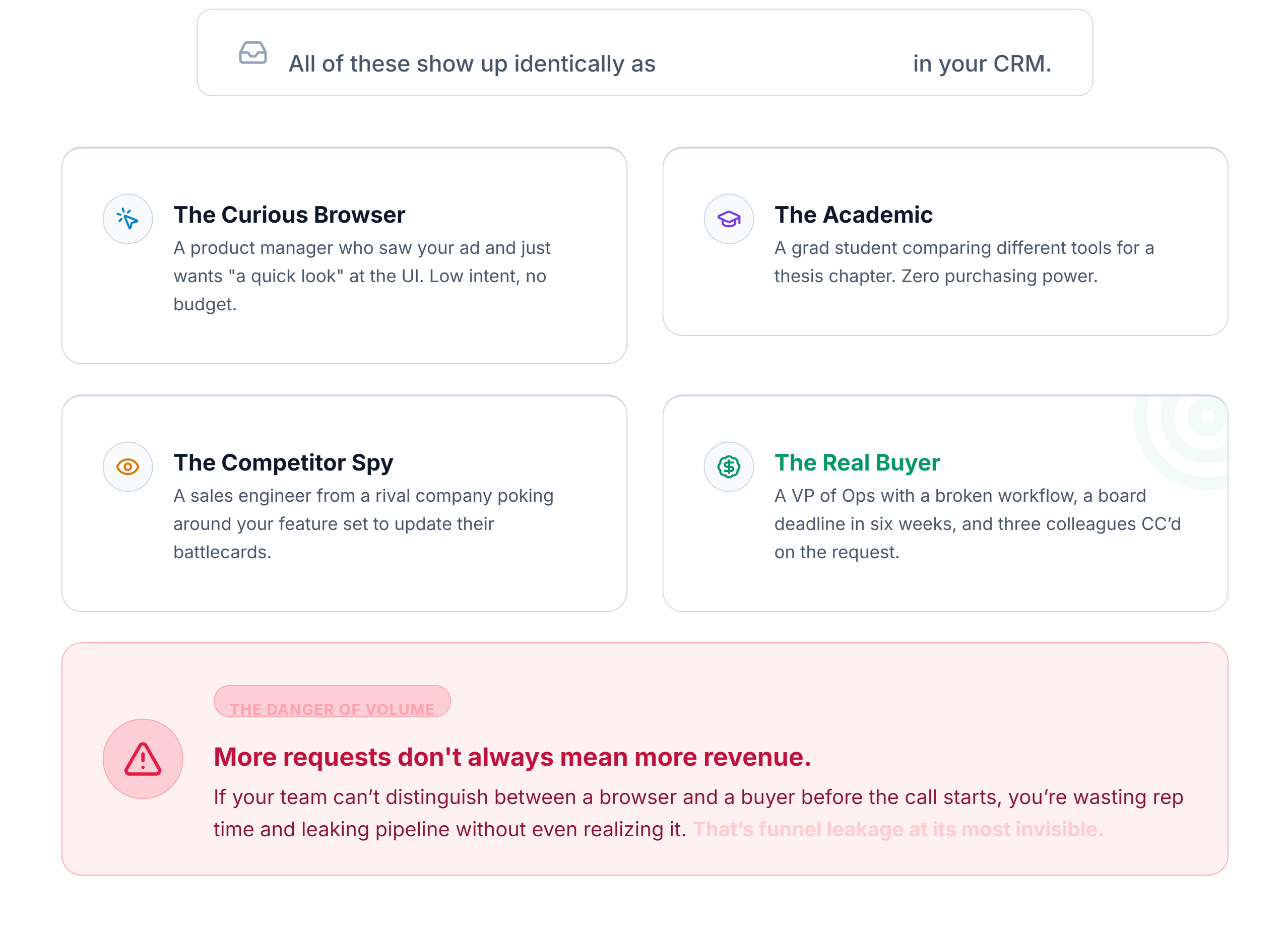
Here’s what I mean. Your demo queue might contain:
- A curious product manager who saw your ad and wants “a quick look”
- A grad student comparing tools for a thesis chapter
- A competitor’s sales engineer poking around your feature set
- A VP of Operations with a broken workflow, a board deadline in six weeks, and three colleagues CC’d on the request
All four show up as “1 new demo request” in your CRM.
More demo requests don’t always mean more revenue. The fastest-growing SaaS teams prioritize intent, not volume. If your team can’t distinguish between a browser and a buyer before the call starts, you’re leaking pipeline without even realizing it. That’s funnel leakage at its most invisible.
 What Is a High-Intent Demo Request?
A high-intent demo request is a submission from someone who isn’t just curious — they’re actively evaluating. They have a problem, they know it, and they’re comparing solutions right now.
High-intent requests usually indicate:
- Active evaluation
They’re past the awareness stage. They’ve visited your pricing page, read case studies, and now they want to see the product. - Business urgency
Something is broken, expiring, or under executive pressure. - Buying authority
The person requesting (or the people they mention) can actually sign a contract. - Problem awareness
They can articulate what’s wrong. They’re not looking for education — they’re looking for a fix.
A detailed demo request often tells you more than the demo itself. When you learn to read the signals baked into the submission, you can qualify demo requests before your rep even picks up the phone.
The 7 Signs of a High-Intent Demo Request
This is the core framework. Each signal carries weight independently, but they compound. A request with three or four of these signals? That’s your Tier 1 priority.
Sign #1: They Describe a Specific Business Problem
When a prospect writes “We’re currently losing about 15 hours per week on manual demo scheduling and our follow-up rate is below 30%” — that’s a different animal than “Just exploring options.”
The first one tells you exactly what’s broken. The second tells you nothing. Pain specificity is one of the strongest predictors of conversion because it means they’ve already done the internal work of diagnosing their problem. They’re not asking you to convince them something is wrong — they already know.
Sign #2: Multiple Stakeholders Are Involved
When two or three people from the same company request a demo — or when the requester mentions bringing their director and a technical lead — you’re looking at a buying committee forming in real time.
Larger deals almost always involve multiple stakeholders. A solo individual contributor browsing your site is a lead. A group evaluation is a deal in motion.
Sign #3: They Ask Detailed Product Questions
“Does your platform integrate with Salesforce?” is a different question than “What does your product do?”
Implementation questions, integration questions, workflow-specific questions — these are all signals that someone is mentally placing your product into their existing stack. They’re not wondering if they need something. They’re figuring out if your thing fits.
This is one of the clearest buying signals you’ll encounter at the demo request stage.
Sign #4: They Match Your Ideal Customer Profile
Company size. Industry. Use case. Role.
If the request comes from a 200-person B2B SaaS company and your best customers are 150–500 person B2B SaaS companies, that’s a strong ICP match. If it comes from a solo freelancer in an industry you’ve never served, it’s probably not.
Checking ICP fit takes seconds and saves hours. This is the foundation of identifying qualified SaaS leads.
Sign #5: They Need a Solution Soon
“We need to be live by the end of Q2” is a fundamentally different request than “We might look at this next year.”
Urgency tied to a project deadline, a contract expiration, or an operational crisis compresses the sales cycle. These prospects aren’t comparison-shopping for fun. They’re solving a problem under pressure — and lead response time matters enormously here. Delay destroys intent. The same signal becomes weaker when acted on later.
Sign #6: They Complete Detailed Demo Forms
Here’s something I’ve noticed consistently: prospects who fill out every field on a longer form — role, company size, current tools, timeline — are almost always more serious than those who skip optional fields.
The common objection is that more fields lower conversion rates. That’s partially true. But the practical goal isn’t collecting the maximum number of fields — it’s capturing the right decision variables. Timeline, team size, and current tools tell you more than name and email ever will.
If your demo request form captures the right signals, it becomes a qualification engine, not just an intake form.
Sign #7: They Engage After Booking
The demo is booked. Do they respond to the confirmation email? Do they confirm the calendar invite? Do they click the prep materials you sent?
Post-booking engagement is an underrated signal. Prospects who go silent after submitting a form have a significantly higher no-show rate. Those who reply, confirm, or ask pre-demo questions are telling you they’re invested.
Track this. It directly impacts your demo booking rate and forecasting accuracy.
Red Flags That Suggest Low-Intent Demo Requests
Not every demo request deserves the same response strategy. Watch for:
- Students and researchers
Academic email addresses, vague use cases, no company context. - Competitors
Requests from companies in your space. They’re scouting, not buying. - Generic submissions
“Just want to see a demo” with no additional context. - Missing or fake information
Incomplete forms, obviously fake company names, disposable email addresses. - Zero post-booking engagement
No confirmation, no replies, no calendar acceptance.
These requests still deserve a response — just not the same response. Route them to self-serve resources or nurture sequences instead of burning a senior rep’s calendar slot.
How SaaS Teams Can Score Demo Request Intent
A simple scoring framework makes this operational instead of subjective. Here’s one that works:
Scoring tiers:
- High Intent: 25+
→ Immediate Tier 1 follow-up. Senior rep assigned. - Medium Intent: 15–24
→ 48-hour follow-up window. Standard SDR outreach. - Low Intent: Below 15
→ Nurture sequence. Self-serve demo or content track.
This tiered framework turns gut instinct into a repeatable system. And it gives marketing and sales a shared language for what “qualified” actually means.
How Lead Routing Depends on Intent Quality
High-performing teams route opportunities based on intent quality, not submission order.
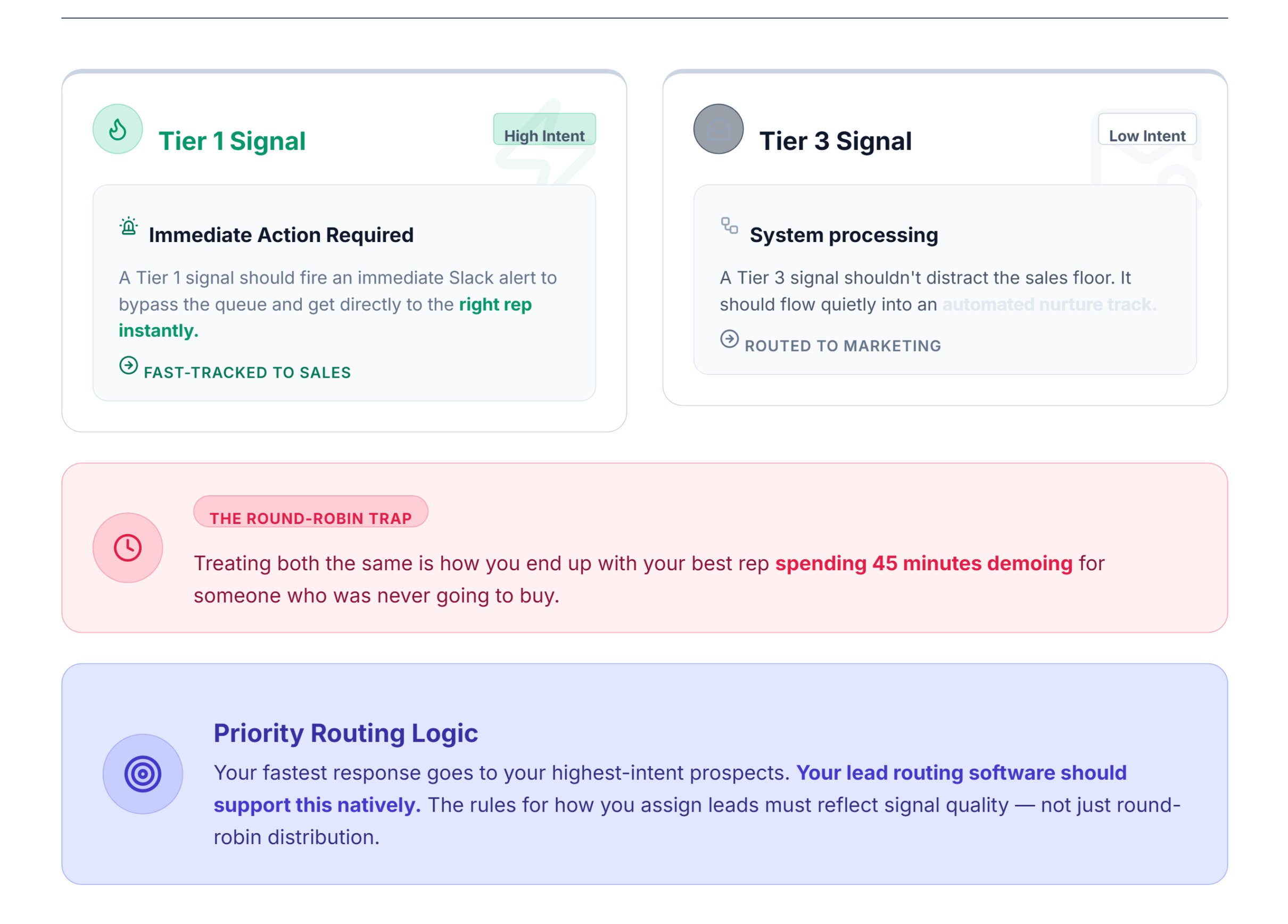
A Tier 1 signal should fire an immediate Slack alert to the right rep. A Tier 3 signal should flow into an automated nurture track. Treating both the same is how you end up with your best rep spending 45 minutes demoing for someone who was never going to buy.
Priority routing means your fastest response goes to your highest-intent prospects. Your lead routing software should support this logic natively. And the rules for how you assign leads should reflect signal quality — not just round-robin distribution.
Common Mistakes Teams Make When Evaluating Demo Requests
Five patterns I see constantly:
- First come, first served. Fair? Sure. Effective? No.
- Ignoring the form data. Teams collect qualifying information and then never use it for routing or prioritization.
- Routing everything equally. Every request goes to the same queue, the same workflow, the same rep rotation.
- Delayed follow-up on strong signals. A Tier 1 request acted on three hours later has already lost momentum. Speed matters more than signal purity.
- Optimizing for volume over quality. Teams frequently optimize for more submissions instead of more qualified submissions — and then wonder why their SaaS leads don’t convert.
How High-Performing SaaS Teams Identify Intent Earlier
The best teams don’t wait for the form submission to start qualifying.
They track signal clusters — pricing page revisits, feature page exploration, case study downloads — all happening in a compressed window. A demo request paired with three pricing page visits in the same week is a completely different signal than a cold form fill.
Conditional logic adapts the form based on the prospect’s self-reported profile. An enterprise buyer sees different fields than an SMB founder. The form itself becomes a qualification layer.
Automated confirmation sequences include a calendar link, a relevant proof point, and a pre-demo questionnaire. Engagement with these assets updates the lead score in real time — so by the time the rep opens the CRM record, the intent picture is already built.
This is where most teams stall. They collect engagement data in analytics but never surface it where reps actually work. The fix is pushing behavioral signals directly into CRM fields so the lead score — and the reason for it — is visible inside the rep’s workflow.
How LevelUp Helps Teams Identify High-Intent Demo Requests
This is where the operational layer matters. LevelUp gives teams qualification visibility right from the demo request form — auto-logging leads, categorizing by intent signals, and routing to the right rep based on the criteria that actually predict conversion.
The follow-up management view keeps accountability visible. The analytics dashboard tracks request-to-show rate, demo-to-close rate, and conversion metrics in one place. No bloated CRM migration required. It sits alongside your existing tools and handles the demo operations layer that most CRMs completely ignore.
For teams building a sales pipeline around demos, it’s the operational backbone that turns qualification logic into daily workflow.
LevelUp Demo
Send your fastest response to your best prospect.
LevelUp auto-logs demo requests, scores them by intent signals, and routes the highest-intent prospects to the right rep — so your best opportunities never wait in a first-come queue.
FAQ
What is a high-intent demo request?
A high-intent demo request comes from a prospect actively evaluating solutions, showing signals like specific business problems, urgent timelines, ICP fit, and multi-stakeholder involvement. These requests have the highest probability of converting into pipeline and closed revenue.
How do you identify high-intent leads?
Score demo requests against behavioral and demographic signals: ICP match, urgency, stakeholder involvement, form detail, product-specific questions, and post-booking engagement. Use a tiered framework to separate Tier 1 (immediate action) from Tier 2 and Tier 3 signals.
What signals indicate buying intent?
The strongest signals include describing a specific business problem, mentioning a timeline, involving multiple stakeholders, asking implementation or integration questions, and engaging with confirmation emails after booking.
How should SaaS teams prioritize demo requests?
Use an intent scoring model that assigns points to qualifying signals. Route high-scoring requests to senior reps immediately. Send medium-scoring requests through standard SDR outreach. Funnel low-scoring requests into nurture or self-serve tracks.
Why is lead qualification important?
Without lead qualification, teams spend equal time on every request regardless of conversion probability. Qualification ensures your fastest, most experienced reps work the deals most likely to close — protecting both revenue and rep capacity.