
The demo ends. Everyone smiles. The prospect says, “This looks great—we’ll get back to you.”
They never do.
You replay the conversation. Your product solved their exact problem. The demo was smooth. They asked good questions.
But three weeks later, the deal is marked “lost” in your CRM, and you have no idea why.
This isn’t about your product. It’s about what happened before you opened your screen share—and what didn’t happen after you closed it.
Reader Promise: By the end of this guide, you’ll understand the three hidden failure points that kill SaaS demos, why follow-up matters more than pitch quality, and how to build a demo workflow that actually converts.
The Myth: “If the Product Is Good, Demos Will Convert”
Most SaaS founders believe product quality drives demo success. It doesn’t.
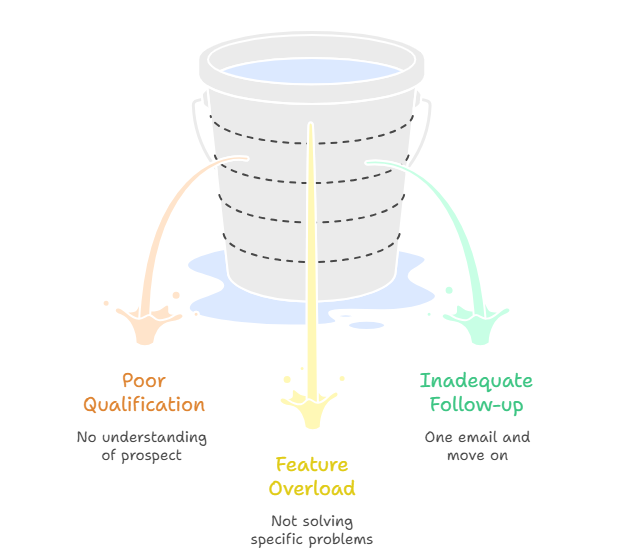
In most small SaaS teams, 73% of demos fail not because the product is weak, but because the sales demo process breaks down at three predictable points: qualification, execution, and follow-up.
Here’s what actually happens:
- Before the demo: You accept every demo request without understanding the prospect’s timeline, budget, or decision-making authority.
- During the demo: You default to showing all your features instead of solving their specific problem.
- After the demo: You send one follow-up email, get no response, and move on.
The product never gets a fair shot because the process surrounding it is broken.
The Discovery Depth Gap
Sales reps who ask 11–14 strategic questions before the demo achieve 74% higher close rates. Most reps ask 3–5.
That gap isn’t knowledge—it’s execution. You know you should qualify leads. You know you should ask about pain points.
But when a demo request comes in, the pressure to “show the product” overrides everything else.
The irony? Problem-centered discovery (asking about challenges) beats product-focused conversations by 28%.
Yet most reps reverse this order, pitching before understanding.
📉 2026 Discovery Benchmark
Recent sales data shows that the sweet spot for discovery calls is shifting. While 11-14 questions is ideal, the timing matters more. Teams that conduct a separate 15-minute “discovery sprint” before the demo call see a 40% higher win rate than those who combine discovery and demo into one hour-long session.
Where Demos Actually Fail: The Three Hidden Breaking Points
Breaking Point #1: Before the Demo (Bad Qualification)
Your demo request form captures a name, email, and company size. That’s it.
You schedule the call. Show up prepared to present. And within five minutes, you realize:
- They’re not the decision-maker
- They don’t have budget allocated
- They’re “just exploring options” with no timeline
- They thought your product did something completely different
This is the feature dumping trap in reverse. You’re not dumping features—you’re accepting unqualified demo requests and wasting 60 minutes on prospects who were never going to buy.
Visual Checkpoint: If your CRM doesn’t show 3+ documented pain points before the demo is scheduled, you’re flying blind.
The Verification: Can you describe this prospect’s biggest challenge in one sentence without checking your notes?
If not, you skipped discovery.
Breaking Point #2: During the Demo (Wrong Expectations)
You open the call. The prospect asks, “So what does your product do?”
That question is a red flag. It means they don’t know why they’re here.
Most reps respond by clicking through 8+ features in a 60-minute presentation. The prospect’s eyes glaze over.
They stop taking notes. They ask about pricing halfway through—not because they’re interested, but because they’re trying to end the meeting.
This is where contextualized demos separate winners from losers.
Generic feature walkthroughs fail. Demos that use the prospect’s actual data, workflows, and real-world scenarios convert.
If you’re selling restaurant SaaS, showing their menu items and waste reduction projections beats a generic “here’s how inventory management works” every time.
The Demo-to-Value Timeline Reality
Restaurant SaaS buyers need 30–60 day ROI proof. Enterprise SaaS expects 6–12 months. If your demo promises “future benefits” without matching their timeline expectations, you lose credibility immediately.
Small vertical SaaS companies often fail here because they treat every demo the same way. A restaurant operator can’t afford a 6-month implementation. They need to see value in week one—or they’re gone.
Visual Checkpoint: A successful demo runs 20–30 minutes (not 60+), focuses on 2–3 specific workflows addressing documented pain points, and ends with an explicit next-step commitment.
The Verification: Did the prospect take notes on ROI impact? Did they ask implementation questions? If they only asked about price, you lost them.
Breaking Point #3: After the Demo (No System)
This is where deals actually die.
You send one follow-up email. Maybe two. No response. You mark the deal “lost” and move on.
Meanwhile, top-performing reps execute 4–6 high-context follow-ups over 2–3 weeks.
Each touch adds new value: a case study, an ROI calculator, a customer testimonial, an implementation timeline.
The difference isn’t activity—it’s persistence cadence. Average reps do 10+ low-context touches (“just checking in”). Top reps do fewer touches with higher relevance.
Only 41% of SaaS reps hit quota. This is why. The focus and follow-up discipline is missing.
The Ugly Truth About Follow-Up
Across multiple demo reviews, the pattern is consistent: most SaaS teams lose deals after the demo, not before.
Poor follow-up is the leading cause of lost opportunities, yet demo outcome tracking is often missing in small teams.
You don’t have a conversion problem. You have a visibility problem.
When demo requests, outcomes, and follow-ups aren’t tracked in one place, even great demos fail to convert. There’s no system to remind you when a prospect goes silent. No documentation of what was promised. No accountability for next steps.
Visual Checkpoint: Your CRM should show 4–6 follow-up touches over 2–3 weeks, each with new value. If you’re seeing single follow-up emails, your persistence cadence is broken.
The Verification: Can you see every demo outcome (Won, Lost, In Follow-up, Pending) in one dashboard? If not, you’re guessing.
Why Follow-Ups and Outcomes Matter More Than Pitch Quality
Let’s address the uncomfortable truth: your demo pitch probably isn’t the problem.
You’ve practiced it. You’ve refined the slides. You’ve A/B tested the opening hook.
But none of that matters if you don’t have a system to capture what happens next.
The Onboarding Friction Blind Spot
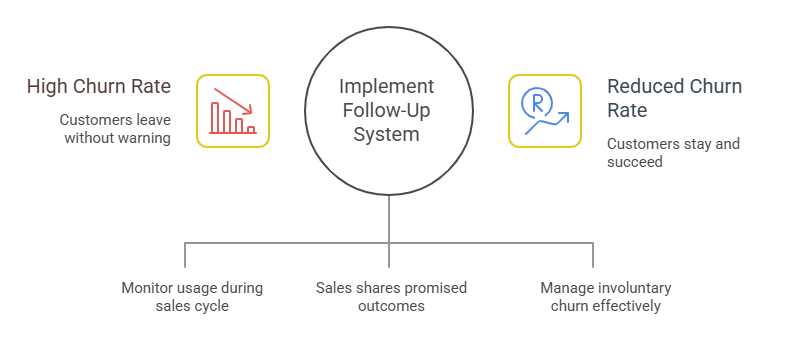
Here’s where vertical SaaS companies get burned: 70–80% of churning customers show warning signs 30+ days before cancellation.
But most teams start monitoring usage post-sale, not during the sales cycle.
Early intervention (days 1–30) prevents 90-day churn. Yet the handoff from sales to customer success is where context gets lost.
Sales promised specific outcomes. CS doesn’t know what those were. The customer logs in once, then goes silent. No one reaches out until month two—when it’s too late.
This is an onboarding friction problem disguised as a product adoption problem. Staff training determines success.
The Involuntary Churn Recovery Gap
20–40% of churn is involuntary—failed payments, expired cards, outdated billing info.
One company reduced involuntary churn from 12% to 2% in three months via automated dunning management, recovering $50K ARR.
Yet most SaaS companies treat this as “acceptable loss.”
The connection to demos? If your LTV:CAC ratio is below 3:1, every lost demo compounds.
Your CAC is $5K but LTV is only $12K. You can’t afford to lose deals because of broken follow-up systems.
The Verification: What percentage of your churn is involuntary? If you don’t know, you’re leaving revenue on the table.
How Small SaaS Teams Unknowingly Break Their Demo Process
You’re doing everything the industry says to do:
- Customizing demos to prospect pain points
- Asking discovery questions
- Following up consistently
- Monitoring product usage
But deals still stall. Why?
Because execution beats knowledge. You know what to do—you’re just not doing it systematically.
The Quota Attainment Crisis No One Talks About
Only 41% of SaaS reps hit quota in 2025–26. This isn’t a talent problem. It’s a focus problem.
Most teams lack:
- Discovery depth discipline: 11–14 questions per prospect, documented before the demo
- Persistence cadence structure: 4–6 high-context follow-ups, scheduled in advance
- Outcome visibility: Clear tracking of Won/Lost/In Follow-up status
The industry treats this as normal. It’s not. This is a systematic process failure.
The Reality Check
Can you answer these questions right now?
- How many demo requests came in last month?
- What percentage converted to qualified opportunities?
- How many deals are in follow-up limbo?
- What’s your average response time after a demo?
If you’re guessing, your demo process is broken at the system level—not the pitch level.
What High-Converting Demo Workflows Do Differently
They treat demos as a workflow, not an event.
Phase 1: Pre-Demo Qualification
Directive Steps:
- Capture 5+ qualification data points before scheduling (role, timeline, budget, current solution, specific pain point)
- Document these in your CRM with a “Go/No-Go” decision
- Send a pre-demo questionnaire asking about their current workflow and success metrics
Visual Checkpoint: Your CRM shows 3+ documented pain points linked to this prospect before the demo is scheduled.
The Verification: If the prospect can’t articulate their challenge, reschedule and do a discovery call first.
Expert Nuance: The demo-to-value timeline varies by vertical. Restaurant SaaS needs 30–60 day proof. Enterprise needs 6–12 months. Qualify for timeline fit, not just budget fit.
Phase 2: Demo Execution
Directive Steps:
- Open with their documented pain point, not your product overview
- Show 2–3 workflows that solve their specific problem using their data
- End with explicit next steps (implementation timeline, contract review, stakeholder intro)
Visual Checkpoint: Demo runs 20–30 minutes. Prospect takes notes on ROI impact. They ask implementation questions, not just pricing.
The Verification: Did you get a commitment to a specific next action with a date? If not, the demo failed.
Expert Nuance: Contextualized demos using prospect-specific scenarios convert. Generic feature tours don’t. If you’re selling to restaurants, show their menu items and waste projections—not a template.
Phase 3: Post-Demo Follow-Up
Directive Steps:
- Send first follow-up within 24 hours with demo recap and promised materials
- Schedule 4–6 additional touches over 2–3 weeks, each adding new value (case study, ROI calculator, customer testimonial)
- Track outcome status (Won/Lost/In Follow-up/Pending) in a centralized dashboard
Visual Checkpoint: Your follow-up cadence is documented. Each touch has a specific purpose. You can see all demo outcomes in one view.
The Verification: If a deal goes silent, you have a system to flag it—not just your memory.
Expert Nuance: Persistence cadence separates top performers from average reps. Most do 10+ low-context touches. Winners do 4–6 high-relevance touches.
The System Fix: Turning Demos Into Trackable Workflows
Tools like LevelUp Demo exist to solve exactly this gap—turning demos into a trackable workflow instead of a one-off meeting.
The shift isn’t about adding more software. It’s about treating demo conversion rates as a system problem, not a sales skill problem.
When you centralize demo requests, qualification, scheduling, outcomes, and follow-ups in one place, you stop losing deals to broken processes.
Stop Losing Deals to Broken Follow-Up Systems
LevelUp Demo helps small SaaS teams track every demo from request to close—without the complexity of traditional CRMs. Capture leads, qualify prospects, schedule demos, track outcomes, and manage follow-ups in one lightweight dashboard.
See how LevelUp Demo helps teams avoid post-demo drop-offs →
The Troubleshooting Reality: What Actually Breaks
| Problem | The Weird Fix | Why It Works |
|---|---|---|
| Demos feel positive but don’t convert | Stop customizing your pitch. Standardize your qualification process instead. | You’re optimizing the wrong variable. Discovery depth (11–14 questions) predicts close rates better than demo quality. |
| Prospects ghost after demos | Send the first follow-up within 2 hours, not 24. | Speed-to-follow-up correlates with conversion. Waiting a day signals low priority. |
| Deals stall in “thinking about it” limbo | Ask for a “No” instead of waiting for a “Yes.” | Prospects respect directness. “Should we close this out or is there something blocking you?” forces clarity. |
| High show-up rate but low conversion | You’re accepting unqualified leads. Add friction to your demo form. | More questions = fewer tire-kickers. Quality over quantity. |
| Great product, terrible close rate | Track demo outcomes separately from pipeline stage. | Most CRMs conflate “demo completed” with “qualified opportunity.” They’re not the same. |
FAQ: The Implementation Questions That Actually Matter
Why do SaaS demos fail even when the product is good?
Demos fail because of broken qualification, poor follow-up systems, and missing outcome tracking—not product quality. Most teams lose deals after the demo, not before. The process surrounding the demo determines conversion, not the pitch itself.
Is product quality the main reason demos don’t convert?
No. 73% of SaaS demos fail due to process breakdowns: accepting unqualified leads, feature dumping instead of problem-solving, and lack of systematic follow-up. Product quality gets attention. Process closes deals.
What happens after a demo that causes deals to stall?
Deals stall when there’s no persistence cadence. Top reps execute 4–6 high-context follow-ups over 2–3 weeks. Average reps send one email and move on. Without a system to track outcomes and trigger follow-ups, even interested prospects slip through.
How many follow-ups should I do after a demo?
Execute 4–6 high-relevance follow-ups over 2–3 weeks. Each should add new value: case study, ROI calculator, implementation timeline, customer testimonial. Avoid low-context “just checking in” emails—they signal desperation, not value.
How do I know if my demo process is broken?
If you can’t answer these questions instantly, your process is broken: How many demos last month? What’s your demo-to-close conversion rate? How many deals are in follow-up limbo? What’s your average response time after a demo? Lack of visibility = broken system.
Product Quality Gets Attention. Process Closes Deals.
Your product is good. That’s not the question.
The question is: do you have a system to turn demos into deals?
Most small SaaS teams don’t. They treat demos as one-off meetings instead of trackable workflows. They accept unqualified leads, skip discovery, feature dump during presentations, and send one follow-up email before moving on.
The fix isn’t better pitch decks or more features. It’s systematic qualification, contextualized demos, and disciplined follow-up cadences.
When you treat the demo process as a workflow—not an event—conversion stops being a mystery.
Stop Leaking Revenue After the Demo
You’ve built a great product. Now build a demo process that actually sells it. LevelUp Demo gives you the visibility and control to close more deals, consistently.
Track outcomes. Automate follow-ups. Close more.