
I still remember the Tuesday afternoon I realized our demo problem wasn’t actually a demo problem.
We’d just wrapped our seventh product demo that week—a solid 45-minute session with a qualified prospect who nodded enthusiastically, asked smart questions, and genuinely seemed excited about our platform. My co-founder turned to me after we hung up and said, “That’s another close.” We high-fived. Then we waited. And waited. Three follow-up emails later, the deal went dark. Just like the six demos before it.
That’s when it hit me: we were pouring all our energy into delivering great demos while completely ignoring what happened after the call ended. The demo itself wasn’t failing—our post-demo process was. Or more accurately, we didn’t have a post-demo process at all.
If you’re running demos for your SaaS product and watching qualified prospects mysteriously vanish afterward, you’re probably making the same mistake we were. This guide walks through what actually converts demos into deals—and spoiler alert, most of it happens after you click “End Meeting.”
What Exactly Does It Mean to Convert Demos Into Deals?
Here’s the thing: demo conversion isn’t about your presentation skills or your product’s feature set. It’s about building a clear, consistent path from “interested prospect” to “paying customer” that removes confusion at every step.
The numbers tell the story. The average close rate in B2B SaaS sits at just 21%, with demo-to-customer conversion typically landing between 10-20%. That means for every ten demos you run, only one or two become customers. But here’s what most founders miss: moving your conversion rate from 20% to 30% isn’t a modest 10-point improvement—it’s a 50% jump in actual sales.
Converting demos into deals means systematically addressing everything that happens between “great demo!” and “here’s our credit card.” It means follow-ups that actually happen, next steps that both parties understand, and objections that get surfaced and resolved instead of killing deals silently.
Why Do Good Demos Still Fail to Close?
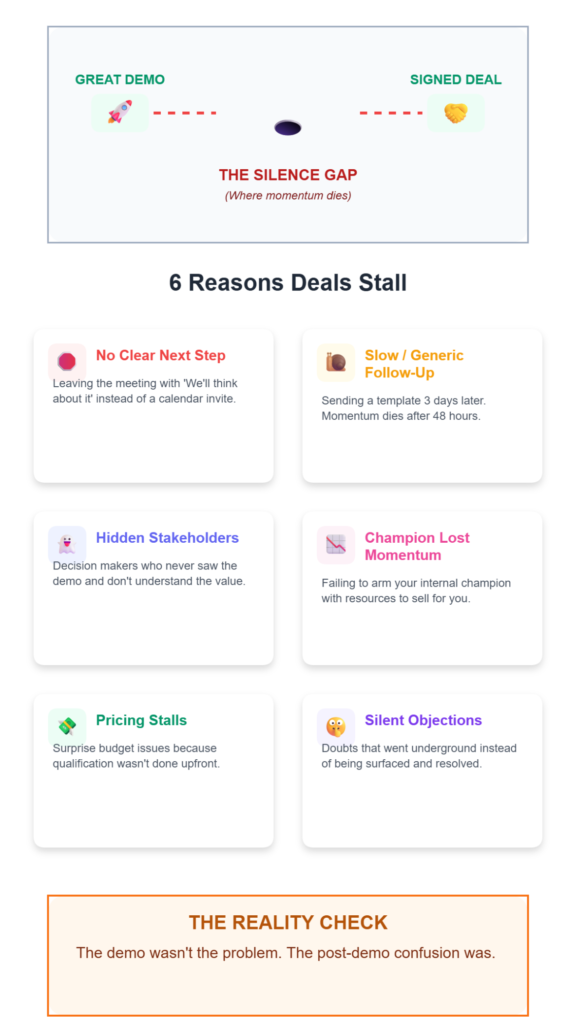
Let me walk you through what typically happens. You deliver an engaging demo. The prospect seems genuinely interested. They say they’ll “discuss internally” or “review with the team.” You send a follow-up email. Then… nothing. You follow up again a week later. Silence. The deal stalls, and you’re left wondering what went wrong.
Here’s what I learned after analyzing dozens of our stalled deals: the demo was never the problem. The confusion that followed was.
Most demos fail to convert because of what doesn’t happen afterward:
- No clear next step was established during or immediately after the demo
- Follow-up happened too slowly or felt generic and impersonal
- Multiple stakeholders appeared who never saw the demo or understood the value
- Internal champion lost momentum because we didn’t give them the right materials
- Pricing conversations stalled because we hadn’t properly qualified budget or timeline
- Objections went underground instead of being surfaced and addressed
The research backs this up. Personalized, timely follow-up is consistently cited as the difference between demos that convert and demos that die[1]. But most small teams treat follow-up as an afterthought—a quick email sent whenever they remember, with no real strategy behind it.
I was definitely guilty of this. I’d finish a demo, get pulled into a product issue, and suddenly realize three days had passed without any follow-up. By then, the prospect’s enthusiasm had cooled, they’d talked to competitors, or they’d simply moved on to other priorities.
This is exactly why we built Levelup Demo. We were losing revenue in the gaps—demo requests coming through website forms, leads sitting in inboxes, scheduling happening in yet another tool, and outcomes never getting recorded. The friction between these disconnected systems was killing our conversion rates. Levelup Demo creates one clean workflow from the moment someone requests a demo through to logging outcomes and understanding what actually drives conversions.
How Does Demo-to-Deal Conversion Actually Work in Practice?
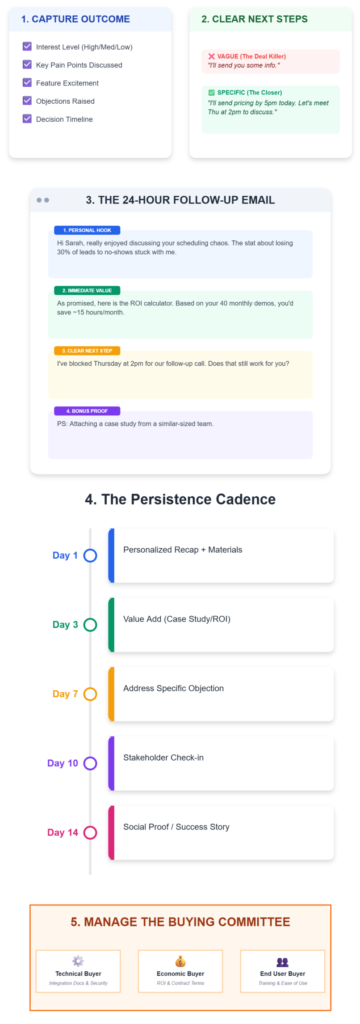
Converting demos into deals requires a structured post-demo workflow. Not a complex CRM with seventeen pipeline stages—just a simple, repeatable process that ensures nothing falls through the cracks.
Here’s the framework that actually works:
1. Capture the Demo Outcome Immediately
Right after the call ends—not tomorrow, not later that afternoon—spend five minutes documenting what happened. I keep a simple template:
- Interest level: High / Medium / Low
- Key pain points discussed: What specific problems resonated?
- Features they cared about: Which capabilities generated questions or excitement?
- Objections raised: What concerns did they voice?
- Decision timeline: When do they need to decide?
- Next step agreed: What did we commit to, and when?
This takes five minutes but saves hours of confusion later. When you follow up a week later, you’re not trying to remember what you talked about—you have clear notes that let you personalize your message.
With Levelup Demo, this outcome logging happens right in the platform immediately after your demo. No switching between tools or trying to remember details later. The demo pipeline keeps all your outcomes visible, so anyone on your team can see exactly where each deal stands without digging through email threads.
2. Establish Next Steps During the Demo
Here’s a mistake I made constantly: ending demos with “I’ll send you some information” or “let me know if you have questions.” These vague next steps are deal killers.
Instead, before the demo ends, explicitly agree on the next step:
- “I’ll send you pricing by end of day tomorrow, and let’s schedule 20 minutes Thursday to discuss any questions.”
- “You mentioned needing to show this to your technical team. How about I record a 10-minute walkthrough focused on the integration points they care about, and we reconvene Friday?”
- “It sounds like you’re comparing a few options. What would be most helpful—a detailed comparison doc, or a follow-up call where I can address specific questions about how we differ?”
Notice the pattern: specific action, specific timeline, specific next meeting. This eliminates the “we’ll get back to you” black hole where deals go to die.
3. Follow Up Within 24 Hours
I used to think I was being respectful by giving prospects “space” after demos. Turns out, I was just losing deals to competitors who followed up faster.
The research is clear: speed matters. Your follow-up email should land within 24 hours—ideally within a few hours if you can manage it. This email should:
- Thank them specifically for their time and reference something unique from your conversation
- Recap the key points that resonated with their situation
- Confirm the next step you agreed to during the demo
- Provide immediate value like a relevant case study, ROI calculator, or answers to questions they raised
Here’s a real example from a recent demo I ran:
“Hi Sarah—really enjoyed our conversation this morning about your team’s struggle with demo scheduling chaos. The stat you mentioned about losing 30% of leads to no-shows really stuck with me.
As promised, here’s the ROI calculator that shows potential time savings: [link]. Based on your 40 monthly demos, you’d likely save about 15 hours/month just on scheduling alone.
I’m sending over pricing details separately, and I’ve blocked Thursday at 2pm for our follow-up call to address any questions. Does that still work for you?
Also attaching a quick case study from a similar-sized team that reduced their demo-to-close time by 40% using our follow-up workflows.”
Notice how this references specific details from our conversation, confirms our next step, and provides concrete value rather than generic fluff.
Levelup Demo’s email automation ensures this follow-up happens automatically and on time. You can set up personalized sequences that trigger based on demo outcomes, and the system pulls in details from your qualification and demo notes to make each message feel personal, not templated.
4. Create Multiple Touchpoints
One follow-up email isn’t enough. Most deals require 5-8 touchpoints before closing[1], but most founders give up after two. The key is making each touchpoint valuable rather than just “checking in.”
I structure follow-ups like this:
- Day 1: Personalized recap email with promised materials
- Day 3: Share a relevant resource (case study, comparison guide, ROI data)
- Day 7: Address a specific objection or question from the demo
- Day 10: Check in on next steps and offer to involve other stakeholders
- Day 14: Share customer success story from similar company
Each touchpoint references something specific from the demo and provides new value. I’m not just saying “following up!”—I’m actively helping them make a decision.
The beauty of Levelup Demo is that your entire follow-up sequence lives in one place alongside your demo data. You can see exactly which touchpoints get responses, which content moves deals forward, and where prospects typically drop off. These conversion insights help you coach your next demo better and refine what actually works.
5. Manage the Buying Committee
Here’s something that killed deals for us early on: we’d run a great demo with one person, then discover three other stakeholders we’d never met needed to approve the purchase.
Now, during every demo, I explicitly ask: “Who else needs to see this before you can move forward?” Then I provide materials specifically for those stakeholders:
- For technical evaluators: Integration documentation, security overview, technical architecture
- For economic buyers: ROI analysis, pricing options, contract terms
- For end users: Quick-start guides, training resources, support information
Better yet, I offer to run separate 15-minute demos tailored to each stakeholder’s concerns. This prevents the “we’re still discussing internally” stall that happens when your champion can’t effectively sell your solution to colleagues who weren’t on the call.
Levelup Demo’s contact management lets you track all stakeholders in one place, so you never lose sight of who needs to be involved. When you’re managing 10+ active demos, having this visibility prevents deals from stalling because you forgot about the CTO who needs to sign off.
What Are the Main Benefits of a Structured Demo Conversion Process?
I’ll be honest—implementing a real post-demo process felt like extra work at first. We were already busy running demos, building product, and handling support. Adding systematic follow-up felt like one more thing on an endless list.
But the results changed my mind fast.
Deals actually close: Our conversion rate jumped from 15% to 28% within two months just by implementing consistent follow-up and clear next steps. That’s nearly double the closed deals from the same demo volume.
Shorter sales cycles: When prospects know exactly what happens next and when, deals move faster. Our average time from demo to close dropped from 32 days to 19 days because we eliminated the confusion that causes delays.
Better qualification: Documenting demo outcomes immediately helped us spot patterns. We realized certain industries converted at 40% while others converted at 5%. That insight let us focus demo capacity on high-probability prospects.
Reduced stress: Having a system meant I stopped lying awake at 2am wondering which prospects I’d forgotten to follow up with. The process handled it automatically.
Clearer team handoffs: When we hired our first sales rep, having documented outcomes and next steps for every demo meant they could pick up deals mid-cycle without confusion. The knowledge wasn’t trapped in my head anymore.
The compound effect is real. Moving from 20% to 30% conversion doesn’t just mean 50% more deals this month—it means 50% more revenue forever if you maintain that rate[3].
This is exactly what Levelup Demo is designed to deliver. With AI-powered lead qualification happening before the demo even gets scheduled, automated reminders cutting no-shows, and a clean demo pipeline that keeps results visible, you get fewer leaks and faster cycles. The platform learns from your wins and losses, showing you patterns you’d never spot manually.
When Should You Implement a Demo Conversion System?
If you’re running more than three demos per week, you need a system. Period.
I tried to wing it when we were doing 8-10 demos weekly, and it was a disaster. Deals slipped through the cracks. Follow-ups happened randomly. Prospects got confused about next steps. We were working harder but converting less.
You definitely need a structured approach if:
- You’re losing track of which prospects you’ve followed up with and when
- Deals are stalling after initial demos with no clear reason
- You can’t quickly answer “what’s the status of the ABC Company deal?”
- Multiple team members are running demos without a consistent process
- Your follow-up emails feel generic because you can’t remember demo details
- Prospects say “we’re still discussing internally” and then vanish
The beautiful thing about implementing a system is that it scales. When it was just me running demos, I could sort of remember everything. But as soon as we added a second person doing demos, the lack of system became obvious. Deals fell through the gaps between us.
Levelup Demo is built specifically for this scaling challenge. You don’t need a massive CRM to get value on day one. Leads flow in from your website and Meta Ads, get AI-qualified automatically, schedule on Google Calendar, and outcomes get logged in one clean workflow. When your second or third team member starts running demos, everyone sees the same pipeline with clear next steps.
Start simple. You don’t need sophisticated software—a spreadsheet tracking demo date, company, outcome, next step, and follow-up status works fine initially. What matters is having a process you actually follow, not having fancy tools.
What Mistakes Should You Avoid With Demo Conversion?
I’ve made basically every mistake possible in this area. Let me save you some pain.
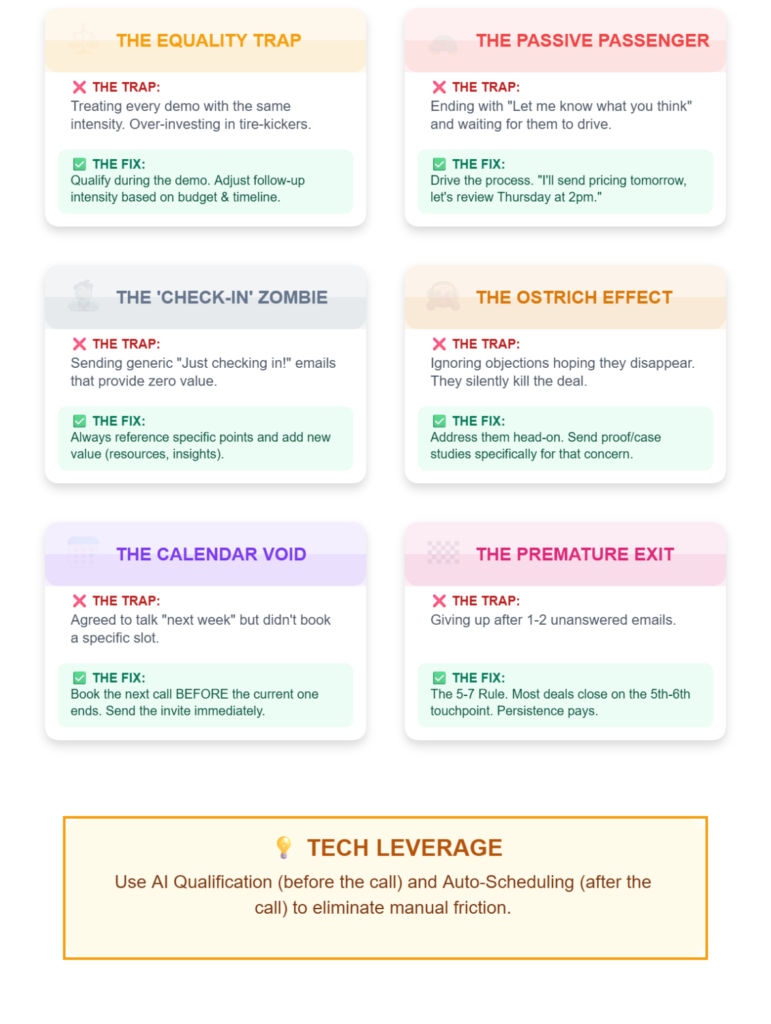
Mistake 1: Treating all demos the same
Not every demo deserves the same follow-up intensity. A highly qualified prospect with budget, timeline, and decision authority needs aggressive follow-up. An early-stage explorer who’s just researching options needs a lighter touch.
I used to spend equal time on every demo, which meant I under-served hot prospects and over-invested in tire-kickers. Now I qualify during the demo and adjust my follow-up intensity accordingly.
Levelup Demo’s AI qualification happens before the demo even gets scheduled, so you know who’s worth intensive follow-up before you invest 45 minutes in the call. The AI enrichment pulls in company data and helps you prioritize which demos deserve your best energy.
Mistake 2: Waiting for prospects to drive next steps
Prospects are busy. If you end the demo with “let me know what you think,” most will intend to follow up but never actually do it. You need to drive the process.
This doesn’t mean being pushy—it means being clear. “I’ll send pricing by tomorrow, and let’s schedule 20 minutes Thursday to review” is helpful, not aggressive. You’re making it easy for them to move forward.
Mistake 3: Generic follow-up emails
“Just checking in!” emails get ignored. “Wanted to see if you had any questions” emails get ignored. Generic follow-ups communicate that you don’t actually remember their specific situation.
Every follow-up should reference something unique from the demo and provide new value. If you can’t do that, you either didn’t take good notes or you’re following up too frequently.
Mistake 4: Ignoring objections
When prospects raise concerns during the demo, many founders either brush past them or promise to “circle back” without actually doing it. Those unaddressed objections kill deals silently.
I now explicitly address every objection raised, either during the demo or in immediate follow-up. If a prospect says “I’m worried about implementation time,” my next email includes a customer story about quick implementation, a typical timeline breakdown, and an offer to discuss their specific situation.
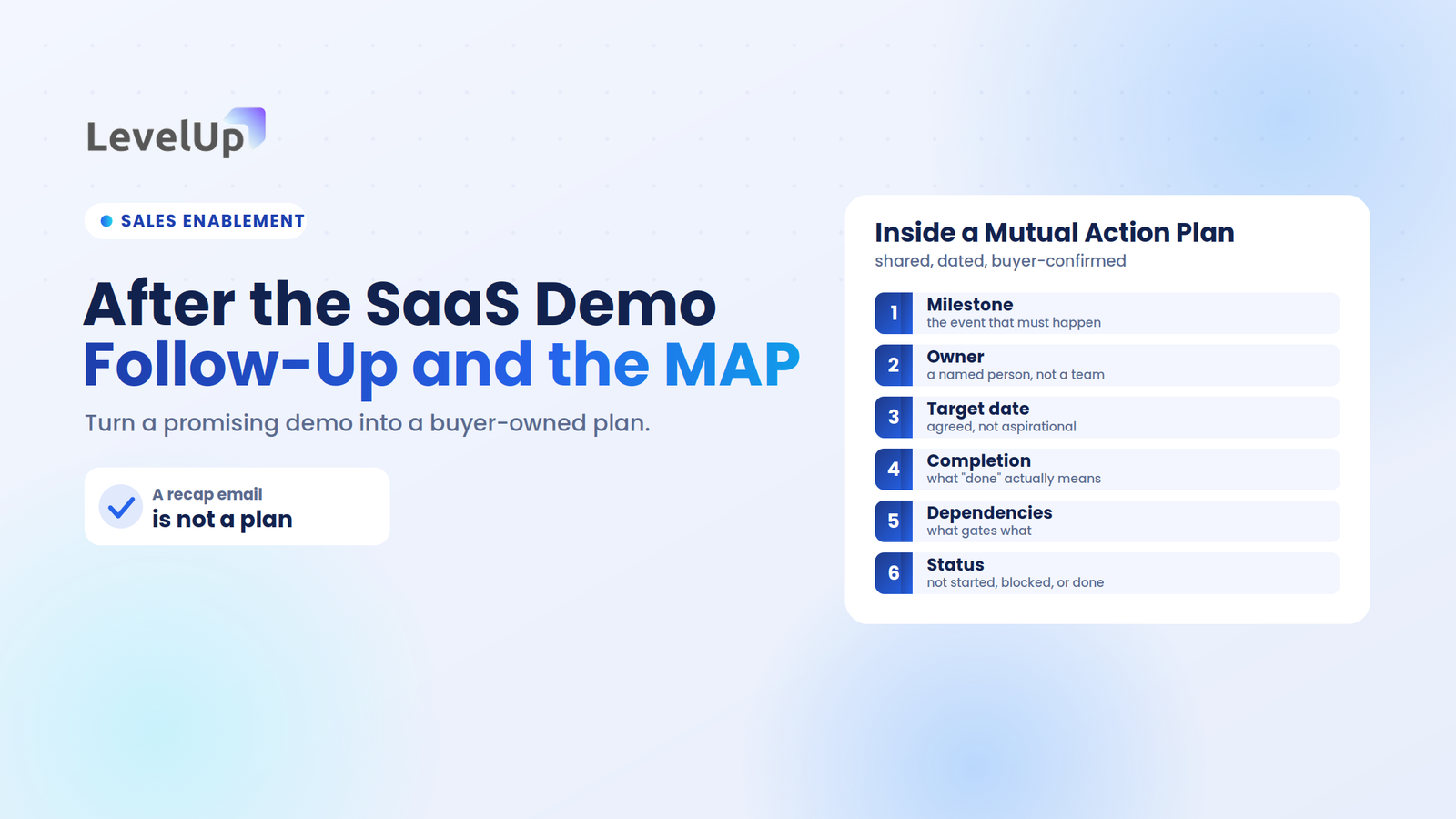
Mistake 5: No ownership of next steps
Saying “let’s reconnect in a week” without actually scheduling the meeting means it probably won’t happen. Both of you get busy, the week passes, and suddenly it’s been three weeks with no contact.
I now schedule the next meeting before the current one ends, or I immediately send a calendar invite in my follow-up email. Don’t leave next steps to chance.
Levelup Demo’s scheduling integration with Google Calendar makes this seamless. You can book follow-up calls right from the platform, and reminders go out automatically so both parties show up.
Mistake 6: Giving up too early
Most founders follow up 1-2 times and then give up. But buyers are busy, and just because they didn’t respond to your first two emails doesn’t mean they’re not interested.
I now follow up 5-7 times over 2-3 weeks with valuable content each time. You’d be surprised how many deals close on the fifth or sixth touchpoint because that’s when the prospect finally had time to focus on the decision.
How Do You Track Demo Outcomes Effectively?
Early on, I tried to remember demo details in my head. Terrible idea. After your third demo of the day, they all blur together.
You need a simple system to capture outcomes immediately. Here’s what works:
Essential information to capture:
- Company name and prospect contact details
- Demo date and who ran it
- Interest level (High / Medium / Low / Not a fit)
- Top 3 features they cared about
- Objections or concerns raised
- Decision timeline and budget indication
- Buying committee members mentioned
- Specific next step agreed
- Follow-up due date
How to actually do this:
Right after the demo, before you move to the next task, spend five minutes filling this out. I keep a simple template in our CRM, but honestly, a spreadsheet works fine if that’s what you have.
The key is making this non-negotiable. No matter how busy you are, those five minutes of documentation save hours of confusion later and dramatically improve your conversion rates.
Levelup Demo makes outcome tracking effortless because it’s built into the workflow. Right after your call ends, you log the outcome in the same platform where you scheduled the demo. No context-switching, no trying to remember details hours later. The demo management system keeps everything—qualification data, scheduled time, demo notes, outcomes, follow-up status—in one clean view.
Tag features viewed:
One insight that really helped us: tagging which features prospects spent time on during demos. After three months, we noticed a pattern—prospects who spent significant time on our scheduling automation converted at 45%, while those focused on reporting converted at only 12%.
This helped us restructure our demo flow to emphasize high-conversion features and spend less time on features that didn’t move the needle.
With Levelup Demo’s conversion insights, you can see exactly which features, industries, or qualification criteria correlate with wins. The platform learns what works by analyzing your outcomes over time, helping you coach better demos and focus on what actually drives revenue.
What Should Your Follow-Up Sequence Look Like?
Here’s the follow-up sequence that consistently works for us:
Immediate (same day):
Send a brief thank-you text or email within 2 hours confirming the next step you agreed to during the call.
Day 1:
Detailed follow-up email with demo recap, promised materials, and confirmation of next meeting. Include something valuable they didn’t expect—a relevant case study, ROI calculator, or comparison guide.
Day 3:
Share a specific resource addressing their main pain point or objection. Don’t ask for anything—just provide value.
Day 7:
Check in on progress toward their decision. Offer to involve other stakeholders or answer specific questions. Include a customer success story from a similar company.
Day 10:
Address any remaining objections with evidence. Share implementation timeline, security documentation, or whatever information would help them move forward.
Day 14:
Final value-add email. Share an industry insight, relevant data, or tool that helps them even if they don’t buy from you. This builds goodwill and often revives deals you thought were dead.
Adjust timing based on their decision timeline. If they need to decide in a week, compress this. If they’re evaluating over two months, spread it out and add more touchpoints.
Levelup Demo’s email automation handles this entire sequence for you. Set up your follow-up cadence once, and the system executes it based on each demo’s outcome. You can customize timing and content based on lead qualification data, ensuring hot prospects get faster, more intensive follow-up while early-stage explorers get a lighter nurture sequence.
How Do You Handle Multiple Stakeholders?
This is where many deals die. You run a great demo with one person, but then three other people you’ve never met need to approve the purchase.
Here’s what works:
Ask explicitly during the demo: “Who else needs to be involved in this decision?” Don’t assume you’re talking to the only decision-maker.
Offer stakeholder-specific demos: When they mention other people, offer to run targeted 15-minute sessions for each stakeholder focused on their specific concerns.
Provide champion materials: Give your internal champion everything they need to sell your solution internally—one-pagers, ROI calculations, comparison docs, security overviews. Make it easy for them to advocate for you.
Address stakeholder concerns proactively: If they mention “our CTO will need to review security,” immediately send security documentation and offer to schedule a technical deep-dive.
I learned this the hard way. We’d run demos with mid-level managers who loved our product, but then the VP would kill the deal because they had concerns we never addressed. Now I always try to involve all stakeholders early, even if it means scheduling multiple shorter demos.
Levelup Demo’s contact management keeps all stakeholders visible in your demo pipeline. When someone mentions “I need to show this to our CFO,” you can add them to the deal right there, schedule a follow-up demo for them, and ensure no one gets forgotten in the process.
What Does Success Actually Look Like?
Let’s get specific. Here’s what good demo conversion looks like in practice:
You know the status of every demo without having to dig through email or try to remember. You can instantly answer “what’s happening with the XYZ Company deal?”
Prospects aren’t confused about next steps. They know exactly what happens next and when because you’ve been clear and consistent.
Follow-ups happen automatically because you have a system, not because you remembered. Nothing falls through the cracks.
Your conversion rate improves measurably. Track your demo-to-close percentage monthly and watch it climb as your process gets tighter.
Sales cycles shorten because you’re removing the confusion and delays that stall deals.
You spend less time on unqualified prospects because your process helps you identify fit quickly and focus energy where it matters.
For us, this looked like going from 15% conversion and 32-day sales cycles to 28% conversion and 19-day sales cycles in about three months. Same product, same demo quality—just a systematic post-demo process.
This is the transformation Levelup Demo is built to create. One clean workflow from capture through close, with AI doing the heavy lifting on qualification and automation handling follow-up. You focus on the human connection during the demo itself, and the platform ensures nothing gets lost in the gaps afterward.
FAQ
How long should I wait before following up after a demo?
Follow up within 24 hours, ideally within a few hours. Speed matters—prospects who receive quick follow-up are significantly more likely to convert than those who wait days for a response.
How many follow-ups should I send before giving up?
Plan for 5-7 touchpoints over 2-3 weeks, each providing new value. Most deals require multiple touchpoints to close. Give up only after you’ve provided substantial value and gotten zero engagement.
What if the prospect goes silent after the demo?
Continue providing value without being pushy. Share relevant case studies, address objections you heard during the demo, and offer to involve other stakeholders. Many “silent” prospects are just busy and will re-engage when they have time.
Should I send pricing during the demo or after?
Depends on the prospect. For highly qualified prospects with clear budget and timeline, send pricing immediately after. For early-stage prospects, wait until you’ve established stronger value and urgency.
How do I handle “we need to discuss internally”?
Ask specifically who needs to be involved, what concerns they might have, and when they plan to make a decision. Offer to provide materials for their internal discussion and schedule a follow-up for right after their internal meeting.
What should I include in my demo follow-up email?
Thank them specifically, recap key points relevant to their situation, confirm the next step you agreed to, provide promised materials, and add something valuable they didn’t expect like a case study or ROI calculator.
How do I track demo outcomes without expensive software?
Start with a simple spreadsheet tracking company, date, interest level, objections, next step, and follow-up date. You can always upgrade to specialized software later, but a spreadsheet works fine initially. If you’re running 3+ demos weekly, consider dedicated demo management software like Levelup Demo that handles the entire workflow end-to-end.
What if I don’t have time for detailed follow-up?
You don’t have time not to. Demos without proper follow-up convert at 10-15%. Demos with systematic follow-up convert at 25-35%. The time invested in follow-up directly multiplies your revenue.
How do I personalize follow-ups at scale?
Take detailed notes during each demo so you can reference specific details in follow-ups. Use templates for structure but customize key sections with prospect-specific information. Five minutes of personalization dramatically improves response rates. Tools like Levelup Demo can automate the structure while pulling in personalized details from your qualification and demo notes.
When should I mark a demo as lost?
After 5-7 touchpoints with zero engagement over 3-4 weeks. Even then, add them to a quarterly nurture sequence—deals sometimes revive months later when their situation changes.
Conclusion
Converting demos into deals isn’t about delivering perfect presentations or having the flashiest product. It’s about what happens after the demo ends—the follow-ups that actually happen, the next steps that both parties understand, and the objections that get addressed instead of killing deals silently.
The framework is simple: capture outcomes immediately, establish clear next steps during the demo, follow up within 24 hours, create multiple valuable touchpoints, and actively manage the buying committee. These aren’t revolutionary concepts, but consistently executing them will double your conversion rate.
Start with one improvement this week. Pick the weakest part of your current process—maybe it’s slow follow-up, maybe it’s unclear next steps, maybe it’s no system for tracking outcomes—and fix that one thing. Then add the next improvement. Compounding small gains in demo conversion creates substantial revenue growth over time.
When demos are central to your sales motion, having a clear post-demo flow makes a real difference in how deals move forward. The teams that convert consistently aren’t necessarily better at presenting—they’re just better at the systematic work that happens after the call ends.
If you’re ready to stop losing revenue in the gaps between tools and build a demo workflow that actually converts, that’s exactly what Levelup Demo does. One clean system from the moment someone requests a demo through understanding what drives your wins. Fewer leaks, faster cycles, more demos turning into customers.
Want to see how other SaaS teams are increasing their demo requests and improving conversion? Check out our guides on how to increase demo requests and 8 sales tactics to double your sales.